Showing posts sorted by date for query book completed annotated games. Sort by relevance Show all posts

05 August 2026

Book completed - Chess Duels: My Games With The World Champions


I recently completed Chess Duels: My Games With The World Champions (Everyman Chess, 2010) by GM Yasser Seirawan. As part of my study/training process, on a daily basis at lunchtime I normally work through a book of annotated games, ideally written by a master-level player that showcases their internal thought process. There are of course a number of good "Best Games" type books out there - including ones I've previously completed - but I found this one to be uniquely valuable in several respects:

  • Seirawan includes all his career games with the world champions he played against, not just the best ones, which immediately differentiates this collection from others. While in fact he has an excellent competitive record against them, some of the games (win, loss or draw) inevitably feature his blunders and bad decisions. This balance makes the book even more valuable for instructional purposes, since he can provide firsthand explanations of not just why moves (or evaluations) were incorrect, but the thought process behind the choices. It also serves to humanize and normalize even his bad play, which of course we can all relate to from our own experience, making us feel better about chess.
  • The background stories he shares about himself and his opponents are similarly humanizing and provide interesting context to the games. I found the content overall to be appropriately balanced and largely focused on chess-relevant themes, rather than trying to be too biographical. He had particularly fascinating accounts of some of the behind-the-scenes activities of Fischer and Kasparov.
  • While the events of international chess politics are of course historically dated (through 2010), this is still the best review and set of insights into those World Championship-level issues that I've seen. Personally one of the reasons I was turned off from an interest in tournament chess for a number of years after college was the interminable series of Kasparov-Karpov matches, which were followed by a fragmented, confusing and opaque world championship process. Seirawan provides an insider and largely objective viewpoint on all this, without letting it become too much of a rant.
  • For those familiar with his live commentary style, Seirawan's authorial "voice" is similarly clear and well-organized, as well as being appropriately humorous (often self-deprecating) while still taking his subject matter seriously.
  • Factors that were behind historical world championship controversies are still relevant to what we see in today's top-level chess scene, as evident in the following excerpt, where Seirawan comments on Garry Kasparov's retirement from competition in 2005:
Kasparov's retirement left the chess world in a sad state. It was denied the joy of seeing Kasparov play, and the World Championship title itself no longer seemed to have legitimacy. After all, the title only meant something if chess players around the world thought it did. With multiple and ever-changing Champions, and shorter and shorter matches, the chess world could really only look to the rating list to determine who was "number one."

08 March 2025

Book completed: John Nunn's Best Games, 1985-1993


I recently completed John Nunn's Best Games 1985-1993 (Batsford Chess Library, 1995), annotated by the author. GM Nunn is one of the chess world's most accomplished and interesting authors, and has been referenced multiple times on this blog. Some of his other works are specifically aimed at improving players; this is not one of them. 

I would say it falls into a similar category as Victor Korchnoi's best games collection - these high-level annotated games are similarly high-quality, but have relatively little hand-holding for Class-level players. The benefit of studying annotated games collections from the author's own perspective is that you get a unique window into both their chess-related thought process and general psychological factors affecting the game. Nunn's thought process insights are uneven in their level of detail, but in many of the games he does provide more of an explanation of the positions' key characteristics and his evaluations, making them very pertinent for improving players. The biographical details are both personally interesting and lend useful context into his state of mind for each tournament and game, although the chess politics comments are now mostly irrelevant.

One theme that struck me while reviewing the games was Nunn's mastery of evaluation of compensation, which involves understanding positional factors that outweigh the material balance, in the absence of forcing tactics. His comments in that regard I found particularly useful, and are not something you can easily find in chess training material. Nunn's games were also routinely very tactical and combative, with a lot of King's Indian and Sicilian games, so there was plenty of material there as well for understanding tactical concepts, visualization and calculation.

I'll close this with an example of one of Nunn's games (number 34 in the collection) that I think very well illustrates his mastery of compensation for sacrificed material.


[Event "Belgrade Investbank"] [Site "Belgrade"] [Date "1991.??.??"] [Round "?"] [White "Nunn, John DM"] [Black "Nikolic, Predrag"] [Result "1-0"] [ECO "C19"] [WhiteElo "2610"] [BlackElo "2625"] [PlyCount "69"] [GameId "1165542594732032"] [EventDate "1991.11.??"] [EventType "tourn"] [EventRounds "11"] [EventCountry "YUG"] [EventCategory "15"] [SourceTitle "CBM 027"] [Source "ChessBase"] [SourceDate "1992.04.01"] [SourceVersion "1"] [SourceVersionDate "1992.04.01"] [SourceQuality "1"] 1. e4 e6 2. d4 d5 3. Nc3 Bb4 4. e5 c5 5. a3 Bxc3+ 6. bxc3 Ne7 7. Nf3 b6 8. Bb5+ Bd7 9. Bd3 Ba4 10. dxc5 bxc5 11. O-O c4 12. Be2 Ng6 13. Ng5 Nxe5 14. f4 Nd3 15. Bxd3 cxd3 16. f5 e5 17. Qh5 Qe7 18. Ne6 Kd7 19. Bg5 f6 20. Be3 Na6 21. cxd3 g6 22. Qg4 Bc6 23. Nd4 exd4 24. Bxd4 h5 25. Qh3 g5 26. Rfe1 Qf8 27. Re6 Rh6 28. Qe3 Re8 29. Re1 Nc7 30. Bc5 Qf7 31. Be7 Rh7 32. Qc5 Bb7 33. Qxa7 Kc8 34. Rb1 Rxe7 35. Rxb7 1-0

27 July 2024

Book completed: The Colle System (12th edition) by George Koltanowski


I recently completed The Colle System (12th edition, 1990) by GM (honorary) George Koltanowski. As the quote from its first lesson may indicate, this is more of an old school book on openings than a modern treatment of theory. As such, it was more entertaining and also had some more general chess-related observations, which I found both useful and refreshing. The intended audience is specifically improving club players.

Here's a sample game included in the book, which also illustrates the standard Colle System setup by move 6.

[Event "Sitges"] [Site "Sitges"] [Date "1934.06.05"] [Round "13"] [White "Koltanowski, George"] [Black "Domenech, Rafael"] [Result "1-0"] [ECO "D05"] [PlyCount "47"] [GameId "272191622851"] [EventDate "1934.??.??"] [EventType "tourn"] [EventRounds "13"] [EventCountry "ESP"] [SourceTitle "EXT 1999"] [Source "ChessBase"] [SourceDate "1998.11.16"] [SourceVersion "1"] [SourceVersionDate "1998.11.16"] [SourceQuality "1"] 1. d4 Nf6 2. Nf3 e6 3. e3 c5 4. c3 Nc6 5. Bd3 d5 6. Nbd2 Bd6 7. Qe2 O-O 8. dxc5 Bxc5 9. e4 dxe4 10. Nxe4 Nxe4 11. Bxe4 Bd7 12. O-O Rc8 13. Bf4 f5 14. Bc2 Qf6 15. Rad1 Rfd8 16. Bg5 Qf7 17. Bxd8 Rxd8 18. b4 Bb6 19. b5 Nb8 20. Ne5 Qf6 21. Bb3 Bc8 22. Rxd8+ Bxd8 23. Qc4 Qxe5 24. Qxc8 1-0

The content outline, as presented in the book:

Here are some summary observations. As a 90-page book, I think it's a good investment in chess learning, especially if you have any interest in the Colle System.

Positives:
  • Koltanowski played the opening himself a great deal, against players of all strengths; annotated games of his are included from tournament play against top-level GMs like Paul Keres, from master tournaments, and from simultaneous exhibitions. This gives a better feel for the range of play in the opening structures and not just the theoretical best.
  • Similarly, a range of other famous masters' games in the Colle are included, which may surprise modern readers who think of it as just for club players.
  • As mentioned above, it's not just about opening play. Koltanowski on the second page of lesson one, before getting past move two, presents the ideal endgame pawn structure as one of the main goals of the opening. He also emphasizes the value of endgame training multiple times.
  • Koltanowski does not over-promise success with the Colle, but shows how it can be used as a reasonably safe choice that also has a lot of attacking potential. Many examples bring this point home in the middlegame.
  • The Colle is not in fact presented as a "system" opening, with Koltanowski advocating for varying from the basic setup in several instances, for example when Black brings his light-square bishop out early, or plays in King's Indian Defense style.
Negatives:
  • The 12th edition (algebraic) appears to have been converted from descriptive notation by some sort of automatic process; otherwise, I have a hard time explaining the occasional game score errors where (for example) it's clearly meant Nf6 instead of Nf3 - the original must have been N-KB3. This happens several times, along with some other typos.
  • The material is useful to see but not particularly well-organized, so trying to find (for example) the author's best recommendation for a particular line or position will be difficult.
  • The level of annotations is uneven and is occasionally too brief, I would say, for the club player audience. That said, requiring active engagement with the material (after for example "and now White wins" without further explanation) is not in itself a bad thing for the learning process.
  • One example of the Colle-Zukertort setup is given early on, but then is ignored. This is the reverse of the modern preference and practice of the setups (playing b3 in the Colle-Zukertort instead of c3). 

24 April 2024

Book completed - American Grandmaster: Four Decades of Chess Adventures


I recently completed American Grandmaster: Four Decades of Chess Adventures by GM Joel Benjamin. I had picked it up as a bargain used book from a dealer at chess tournament a while back, and finally decided to read it during lunchtime at work, my interest primarily being for daily annotated games review. It was not particularly well suited for this, however, as the majority of the actual chess content consisted of individual positions, game fragments, or complete scores but with only a couple comments included. There were enough games at a sufficient level of annotation to be worth going through, but this was a minority of it. If you are looking for something more comprehensive and challenging for annotated games but still with a personal perspective, My Best Games by Victor Korchnoi is world class, while GM Walter Browne's The Stress of Chess...and its Infinite Finesse is a much more detailed and improvement-oriented version of a chess career book with well-annotated games.

From my perspective, it seems the book tried to be multiple things, but was mostly a breezy and candid, but not quite a tell-all, recounting of GM Benjamin's chess career. This mostly consisted of complaints (and occasional praise) about tournament conditions, memories of poor treatment (or occasionally special experiences), and chess politics. The Deep Blue vs. Kasparov project got an interesting treatment and GM Benjamin's perspective was certainly unique, although the narrative was not exactly comprehensive. The book was published in 2007 but the focus was on Benjamin's junior and earlier career, really through the 1990s. As such, a lot of the references - especially to the politics and various failed professional associations - feel quite dated. If you weren't around the 1990s, therefore, it's probably not going to be particularly relevant.

31 January 2024

Book completed: My Best Games by Victor Korchnoi (2011 edition)


I recently completed My Best Games (2011 edition) by Victor Korchnoi, which I originally started in late 2022. It took that long for me to go through the 110 games (half as White, half as Black) at a fairly regular pace, with around 20-30 minutes to review each with a physical board. As part of my training process, I normally have an annotated games collection in the study mix, ideally one that includes a player's own comments and considerations, which provides special firsthand insight into the thinking process.

This collection did not disappoint in that regard, as Korchnoi offers a number of valuable insights into chess thinking and performance, beyond specific game considerations and variations; you can see some of them in several previously posted training quotes of the day. I particularly have enjoyed going through Korchnoi's games here and in other collections, such as the My Life for Chess ChessBase video volumes, for several main reasons:

  • Korchnoi was never a chess prodigy and is an example of someone reaching the highest levels (#2 in the world) through "normal" training and hard work. Of course his career and abilities were far beyond average, but the main point is that it did not come automatically to him as a childhood gift.
  • Perhaps for that reason, he has perhaps unique observations and insights into chess performance, principles, and practical considerations - and can articulate them well.
  • While Korchnoi was extremely competitive - being known as "Victor the Terrible" at the height of his career - he also was candid about his mistakes and failings in annotations. He offers up a number of examples of where he passed up draws or played objectively weaker moves or opening setups out of curiosity, fighting spirit, and/or a simple desire for variety. This makes for more interesting chess.
  • Associated with that approach to chess, Korchnoi had one of the widest repertoires and knew how to play a large number of position types.
As with any games collection, when going over it a student needs to do work to understand it on a more personal level, and read it critically. Korchnoi is not particularly consistent in the level of his annotations, sometimes taking the time to give a short variation with a tactic as an explanation, other times simply noting a particular move would be tactically bad, meaning you have to figure out why for yourself. This of course is part of the learning process and why reviewing annotated games in an active way can be so helpful to advancing your chess, because you have to engage with the material and not just accept it.

There are the usual typos or incorrect information present in a few of the game scores and annotations, but I would say no more than around a half-dozen in the entire volume, which isn't bad; all the large game collections I've been through have them due to editorial oversight.

10 April 2021

Video completed: Winning with the Dynamic Caro-Kann (The Deadly Bronstein-Larsen System)

I recently completed "Winning with the Dynamic Caro-Kann (The Deadly Bronstein-Larsen System)" - Foxy video vol. 162, by IM Andrew Martin. Like others in the Foxy series, it is a collection of recorded lectures, in this case centered on selected games that are narrated all the way through by IM Martin. There is no extra content (game data files, interactive quizzes, etc.) It was published in 2014 and although it contains several classic Bronstein-Larsen games, it focuses more on contemporary master-level examples from international tournaments, typically with players in the 2400+ Elo range.

The video display quality unfortunately is poor, as the demo chessboard is low-res. That said, the strengths of the annotated game format in explaining and demonstrating opening and middlegame ideas outweigh the technical minuses. Full games are presented, so it's a useful product for overall chess training as well, since tactics and strategic ideas are discussed all the way through the endgame. Video presentations by knowledgeable commentators like Martin help bring the material alive, much more than studying lists of variations, and I think the format also aids future recall of specific ideas and maneuvers.

There are 15 separate videos included, with a total running time of 2 hours 7 minutes. The first several look at various alternative move 6 options for White, before moving on to provide examples in the main theoretical 6. c3 line; however, later there are also a mix of options shown (primarily with 6. Nf3). The first 12 videos, containing narrated games, Martin at one point refers to as "introductory", and the last three supposedly contain his specific repertoire recommendations in the different move 6 White lines (6. Nf3, 6. g3 and c3 combination, and 6. Bc4). However, these are really just more example games, although he does present them based on his preference for 6...Bf5 in all cases.

It's worth noting that the "alternate" (to 6. c3) White lines are very important to study for a Black player, since they will likely be the most commonly faced. Especially at club level, 6. c3 - which develops no pieces and only moves the pawn forward one square - may not even occur to your opponent as an option. Other move 6 options, particularly the normal-looking 6. Nf3, are likely to appear on the board from White opponents (of whatever strength) who are not familiar with the Bronstein-Larsen. This probably means the majority of White players, in practical terms.

I found the most useful aspect of going through the narrated example games to be Martin's introduction and explanation of typical ideas and maneuvers, although concrete variations are of course also presented. Key recurring concepts highlighted include:

  • Development of Black's light-square bishop to g4 vs. f5
  • Deployment of black's rook to g8 along the half-open file, or alternatively using it to support an early h-pawn advance
  • The typical development plan of ...e6, ...Nd7, and queenside castling followed by a kingside attack
  • Alternative kingside castling for Black and ...Bf5-g6 ideas
  • Formation of Bd6/Qc7 battery when possible
  • Ideas involving ...Qa5+ and moving along the 5th rank subsequently
  • Disruptive ...Bb4 opportunities
  • Timing the pawn breaks/advances ...e5 (either in one go, or after a preliminary ...e6) and ...c5
  • Black's requirement to play actively with threats and counter-threats in the center and on the kingside, while not being afraid of calculating tactical defense ideas on the queenside.
Various Black responses to White's different move 6 choices are given in the introductory videos. The 6. c3 line responses include 6...Qd5 (recommended by Martin as a good alternative), 6...h5 (more chancy), and the standard 6...Bf5.

In general, these types of video lecture resources help fill in gaps when learning openings, since they do more than just go through book variations and give an evaluation at a certain cut-off point. Where to ideally place your pieces and the trade-offs involved in making these kinds of development decisions are what really underpin opening theory and practice. However, these concepts are too rarely explained in simple, practical terms in most opening theory books. Martin here does a good job at highlighting these ideas for the Bronstein-Larsen, across a number of example games.

Although there is a substantial amount of material covered, with Martin at least looking at the main options in each line, I would still consider this product as complementary in nature to more comprehensive "book" materials (in whatever format) and your personal annotated opening repertoire database. Despite the "Winning with..." title, Martin in my view does a decent job of not over-hyping Black's play, which he summarizes as designed to make White feel uncomfortable. He is also careful in his assessments to highlight practical vs. theoretical considerations. Looking at the Bronstein-Larsen variations in depth will require further research and your own evaluation of them, as is the case with all opening study.

17 October 2019

Book completed: Grandmaster Performance by Lyev Polugayevsky


I recently completed Grandmaster Performance by GM Lyev Polugayevsky (alternate spelling Lev Polugaevsky). Note: I have a hardcover of the original Pergamon Press edition (above left), although the currently available edition with Ishi Press (above right) has a similar cover design.

As with previously completed annotated games collections such as Bronstein's Zurich International Chess Tournament 1953 and Walter Browne's The Stress of Chess...and its Infinite Finesse, I used it primarily for single-session reviews of each game, typically taking 15-20 minutes to go through it. I find this to be the ideal amount of time for maintaining focus and being able to absorb the lessons of each game, before moving on to something different. to do this, the games need to be instructive, informative and judiciously well-annotated. Grandmaster Performance fit the bill very well, in all respects.

Contents:

From the author - a preface from which I got Training quote of the day #19

Problems from the first move - this chapter focused on games where opening preparation was a deciding factor.

In search of the truth - featuring attacking games by the author. The chapter title comes from Polugayevsky's preference for objectively sound attacks, rather than attacking for its own sake.

From defence to attack - featuring games where the author is on the defensive, then finds resources to turn the tables on his opponent.

The touchstone of mastery - games where the author won due to strategically outplaying his opponent.

Finale of the chess symphony - includes endgames of particular interest to the author. Most of these games are still fully annotated, although there is one endgame fragment presented in the chapter.

Psychology of the chess struggle - Polugayevsky presents a few key games from his chess career and the considerations that went into his strategic choices in each case, predicated on his own state of mind and his opponents' capabilities and styles.

Grandmaster Performance is elegantly written (and translated) and has an excellent balance in the annotations between explaining moves, providing variations, and "color commentary" by the author. Each chapter holds together thematically, but when going through complete games one learns much more than just a single lesson. Throughout the book, and especially in the last chapter, one also gets a good sense of the practical considerations used by a strong, competitive player in making decisions, as well as the errors that inevitably occur. For improving players, seeing and absorbing this kind of candid, high-level commentary on thought process and decisionmaking is undoubtedly beneficial. It is also psychologically helpful to understand that chess is not a perfect game, even at the grandmaster level, and success comes from finding ways to win, including when under pressure and on the defensive.

22 March 2019

Book completed: How Chessmasters Think


I recently completed How Chessmasters Think by IM Paul Schmidt, who was a strong Estonian player in the Paul Keres era and subsequently emigrated to the United States.  I ran across the book largely by accident a while ago and got it on Kindle, it being hard to find otherwise.  It's rarely referred to in chess improvement literature, but the subject matter seemed to be very relevant.

Rather than a tutorial on how chess players should think, the book is more of a descriptive exercise in how master-level players do think during a game, both on a theoretical and practical level.  The author presents a series of annotated games, but rather than talking about the ideas or giving analysis in the usual method, instead writes annotations based on an imagined thinking process for each player.  Essentially, he answers the question "why did the player choose this move" with a thought experiment for both sides of the board.  Periodically he will also introduce an objective voice (the "critic") when critical moves are overlooked by both players.

I found several advantages to the author's approach and learning benefits from the content.
  • Some clear and valuable explanations of specific strategic considerations in main line openings, especially relatively early choices, which all too often are skipped over.
  • Each of the chapters has a theme regarding chess situations and judgment which can be generalized, at least to some extent, in terms of facing similar future decisions.
  • The games themselves are varied and high-quality, with frequent appearances by world-class players such as Keres, Alekhine, and Euwe, along with games involving Botvinnik, Fine and Capablanca.  Some lesser master games are also included that are relevant and interesting, by people known to the author.
  • The combination of strategic and tactical considerations as part of each side's "thought process" emphasize the practical aspect of thought, rather than pure strategy or tactics, as is often presented.
A couple things were less helpful, from my perspective.
  • A few move typos are scattered throughout the book, in both the game score and given variations.  Most of the time it's clear what the move should be (for example Nc5 instead of Ne5), but in one or two spots it was really head-scratching.  I expect this was due to the Kindle OCR conversion process.
  • The author has the tendency to include 2-3 pages of variations of 8-10 moves and stream-of-consciousness thought in the early middlegame, which make it difficult to keep following the thread.  He admits late in the book that most chess masters will calculate 3-4 moves ahead in non-forcing situations, but that it is necessary to go further when necessary.  So the stream-of-consciousness over the length of a long variation sometimes comes across as a bit artificial.  On the positive side, the moves then play out as part of the game, which makes it much easier to understand what is actually going on.
  • While it's good to have to work things out for yourself, I found some annotations and explanations cut off a bit prematurely or were of the "...and wins" variety, when it wasn't immediately clear why it would win (eventually).  The author seems to have been assuming an advanced (around master-level) audience in those cases.
I would say that players around Class B and up would benefit from the book, which isn't terribly long (16 chapters / games).

06 February 2018

Book completed: The Stress of Chess ... and its Infinite Finesse


I recently finished GM Walter Browne's The Stress of Chess ... and its Infinite Finesse ("My Life, Career and 101 Best Games"), which is his annotated games collection.  You can see previous posts here related to GM Browne, including Annotated Game #1 (simul played in Las Vegas), Training quote of the day #12Insights from GM Walter Browne and GM Walter Browne: 1949-2015.

For chess improvement purposes, it's a great collection and perfect for using to go through a game during your lunchtime at work, which is how I worked through the book (and why it took so long to complete).  I think it's useful for both your chess skill and overall brain health to have some quality chess study time, even if no more than 15-20 minutes, to break up the work day and get your mind thinking about something completely different. (Unless of course you're a chess professional, in which case for your brain health I'd recommend focusing on an activity that had nothing to do with it at all).  I did the same thing with GM David Bronstein's Zurich International Chess Tournament, 1953 and will look for similar types of game collections in the future.

I found Browne's annotations to be relatively short and succinct in words, yet always valuable and relevant.  For chess improvers, another major benefit of going through a collection of a player's own annotated games is that you gain unique insight into their thought and decision-making process.  Browne includes a lot of these types of observations and it's highly educational to see a top-level GM (which he was at his peak) provide casually sophisticated evaluations of positions and share the considerations he took into account when making choices on how to proceed at key points.  As usually occurs when reading others' annotated games, sometimes you have to put some work into figuring out why a particular move is played (or not played) when it isn't explicitly explained or a variation given, but that's part of the value of engaging in effortful study - to grow in understanding by figuring things out for yourself.  Also, as with almost any games collection, there are at least occasionally a few typos and such in the notation that force you to puzzle out the real continuation, but the editorial quality is high enough that these are no more than a very infrequent and temporary distraction.

Browne's career was interesting in its ups and occasional downs, and spanned a long period of time in American chess.  His personal observations about tournaments, opponents, particular controversies and so on are probably of more interest to those with some previous acquaintance with them, or just curious about tournament experiences in general.  I don't think anything would be lost from a chess training perspective by skipping his sometimes encyclopedic accounts of his chess career, although there are some particularly entertaining stories from the decade where he competed the most internationally (roughly from the mid-1970s to mid-1980s).  For those into the poker scene, he also towards the end of his book (and career) recounts some of his professional poker tournament experiences and has some interesting insights in that regard as well.

11 January 2018

Book completed: Mastering Opening Strategy


I recently completed Mastering Opening Strategy by GM Johan Hellsten (Everyman Chess, 2012).  The book took a beastly long time to complete - more on that below - but I think it was worth it, in the end.

Instead of a detailed theory of opening concepts, a la Ideas Behind the Chess Openings, GM Hellsten's book has four core chapters that center around a number of annotated games and long quiz sections, along with a short fifth one on opening preparation.  The chapters are:

1 - The Nature of Development
2 - Crime and Punishment
3 - The Battle for the Centre
4 - Restriction
5 - A Few Words on Opening Preparation

My comments:
  • Chapters 1 and 2 overlap a great deal, in the sense that pretty much all of the examples show how the less developed side is punished for neglecting opening principles regarding the value of rapid piece development.  A lot of them revolve around king-in-the-center positions, which you learn must be cracked open as soon as possible, otherwise the slower side can consolidate.  Piece activity (via development) and looking for opportunities to initiate attacks with early sacrifices, done to open lines in the position (especially towards the enemy king), are key elements that are illustrated repeatedly.
  • Chapter 3 is interesting, as in a number of cases the importance of the center is underlined by efforts on the wings to undermine it.  There are plenty of examples of seizing central territory with pieces and/or pawns and using that to dominate the opponent, though.
  • Chapter 4 is primarily about prophylaxis, with the focus being on limiting (sometimes severely) your opponent's piece development.  This is probably the most sophisticated chapter and underlines the importance of understanding your opponent's plans as much as your own opportunities.  A number of positional crushes are presented at the top levels of professional chess, showing that this really is an effective and important concept.
  • Chapter 5 contains some useful principles on building an opening repertoire, although does not try to be comprehensive.  Hellsten's observations on the opening being the most apropos area of the game for exploring your personal taste/style were quite interesting, especially in light of previous insights shared here on the concept of style in chess.  Basically the idea is that you should look at openings with structural and style similarities when building a repertoire, with a number of different types of factors highlighted.  This is not necessarily a new idea, but Hellsten explicitly focuses on the opening as most suitable for the expression of "style" choices and largely discounts it for middlegame play.
  • Be prepared for a long time factor in working through this book.  Each of the chapters has a number of example annotated games, which works well, then a large number of games (long fragments, sometimes complete games) as quizzes where you are supposed to identify the next move.  For example, Chapter 3 has 34 example games and 37 quiz games.  If you take them seriously and don't blitz through them, even going through relatively rapidly (say 5 minutes per example game and 10 minutes per quiz game), that means a typical chapter will take you around 540 minutes = 9 hours.  So that means around 36 hours total for the whole book.  So if you go hard at it for an hour a day, every day without a break, it will still take you over a month to complete.  I typically did study sessions in 15-30 minute daily chunks, not sequentially and with substantial breaks sometimes, so that meant it ended up taking well over a year to work through it.
  • If you're expecting a detailed, systemic exposition of opening theory and principles, this really isn't the book for it.  If you're looking for a number of well-annotated illustrative games with connecting and recurring themes related to the opening phase, then that better fits the description of this book.  Repetition of the themes has ingrained the basic principles in my chess thinking and should help me take better advantages of these types of opportunities in the future, even without retention of all the details.

05 February 2017

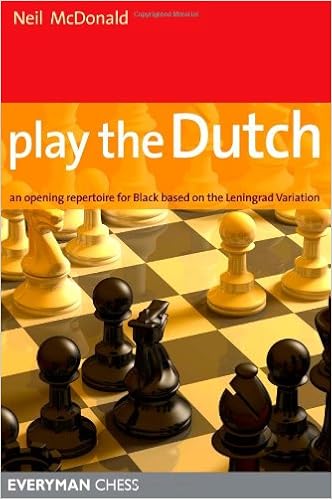
Book completed - Play the Dutch


Image result for play the dutch

I recently completed Play the Dutch by GM Neil McDonald (Everyman Chess, 2010), which per the book's subtitle is "an opening repertoire for Black based on the Leningrad Variation".  It is also a direct follow-up to his Starting Out: The Dutch Defence which provides an orientation to all of the main Dutch variations (Stonewall, Classical and Leningrad).  The "Play the..." series of books are intended to be more focused and intermediate versions of the "Starting Out..." openings series from Everyman.

In this case, McDonald offers his preferred repertoire, although not too narrowly, for example discussing two of the three main options in the main line Leningrad (7...c6 and 7...Nc6) and offering some refinements on the Anti-Dutch sidelines in the earlier book.  Here's the table of contents, for reference:

Gambit Lines and Early Oddities
White Plays 2 Nc3
White Plays 2 Bg5
White Avoids an early g2-g3 against a Leningrad Set-up
Sidelines in the Leningrad Variation
The Main Line Leningrad: 7 Nc3 c6
The Main Line Leningrad: 7 Nc3 Nc6
The Dutch versus 1 Nf3 and 1 c4

Some general observations:
  • The book is very reader-friendly, both in terms of writing style and visual presentation.  To do serious work with it you'll of course need a board and/or database program to review the material, but it can be followed along with only moderate effort on a first read-through.
  • The Leningrad Dutch is a tactics-heavy and sometimes tricky opening, one in which the theory of individual lines (or even whole variations) can change relatively rapidly based on new games and ideas.  This book should not be used for the latest theory, but that's not its intent: it's designed more to present key ideas, themes and specific reasoning behind the highlighted lines, at an intermediate rather than advanced level.  It does this the best of all of the Leningrad Dutch books I have looked at.
  • If you have a coach familiar with the Leningrad, then this book is probably redundant, but for those of us without coaches, it can be quite helpful in getting to the next level of understanding about the opening and its middlegame ideas, something which McDonald emphasizes in the complete annotated games that the book is built around.  He makes the effort to highlight similar plans and themes across games (including things like the ...f4 thrust and the utility of ...Nf6-h5 in attacking situations), which will be very important to achieving practical success using the opening.
  • The book should greatly assist the reader in delving further into Leningrad ideas and exploring lines, but does not offer a 100% concrete, fully tested repertoire.  I don't think this is a bad thing, as long as you realize that the book is a good resource, rather than meant to be used as your gospel and only opening resource.  (Probably a good attitude to have about any openings book.)
  • The main line treatment with 7...Nc6 is welcome, but it's also limited to Black's response 8...Na5 (after 8. d5 is played).  So the other main alternative 8...Ne5 is completely ignored (unlike in the Starting Out book), which means if you are a Black player, you really should take a look at it as well as 8...Na5, given some (known) difficulties there.  GM Viktor Moskalenko's related observations and analysis in The Diamond Dutch are very useful in understanding the trade-offs between the two lines.

10 January 2015

Chess computing resources for 2015 - Part III: Game databases and e-books


In this last part of the series - following Part I on database analysis programs and Part II on chessplaying software - I'd like to look at some of the database resources available and discuss their importance for the improving player.  In addition to standard database files, typically containing very large collections of games in a proprietary or PGN format, there are now online, browser-accessible database references and a large number of e-books which are in reality database files with associated text and annotations.  We'll look at some examples from each category.

Database files

The first indispensable database for any player is one that contains your own games.  Unless you've been keeping separate online records of your games - something many chessplaying sites will now do automatically for you - you will need to manually enter them on your database program board.  This in itself can be a learning experience, so even if you have a stack of old tournament scoresheets lying around, that can be viewed as an opportunity rather than a chore.

I keep separate databases for my over-the-board (OTB) tournament games and slow online games completed at Chess.com (mostly from the Slow Chess League), since I prefer to split the different types of games.  As needed, though, I could easily combine them into a single database by copying and pasting the games into a new one.  The importance of having a personal games database is hard to underestimate, although I think many amateurs often do just that.
  • For the improving chessplayer, at minimum all of your tournament games should be recorded and analyzed to determine what you did right, as well as where you went wrong, and what general and specific lessons you can take away from each game.  Aside from games decided by rare one-move blunders in the opening - which may also be worth remembering for the future - each game then becomes an opportunity for in-depth chess study and research.  See "Analyzing your own games is more than analyzing your own games" for more on this approach to training.
  • Personal databases allow you to generate statistics on your performance at the push of a button.  Even basic stats such as your won-loss record with each color, score and performance rating by opening, and score against different rating categories can lead to new insights and identify unexpected weaknesses (or strengths).
  • Your personal database should be one of the centers of your preparation for future tournaments/games, especially if you have regularly recurring opponents, opening lines, or middlegame and endgame themes.  Understanding and identifying commonalities in past games, including solutions that you reached in subsequent analysis, should guide your expectations for future play.  This helps ensure that the lessons you learn one day are not simply forgotten the next.
Next we have what most people automatically think about when they see the word "database", the very large comprehensive databases with millions of games.  These types of reference databases are fundamental for analysis, research and comparison purposes.  Along with quantity of games, however, quality of games is just as important, and having annotated games included is a major benefit.
  • For ChessBase users, the yearly "Mega" database is the gold standard, primarily because it includes a significant number of games annotated by world-class players.  You can easily search on just annotated games, for example, to get the most out of this feature.  The ChessBase "Big" database version is similarly large, but lacks the annotated games.
  • The other main commercial option, Chess Assistant, comes with a database with a similarly high number of games (over 6 million).
  • Free large-scale databases for download can be found via internet search.  I can't vouch for their quality, but one good place to start for resources is Chessopolis.  To a large extent the freeware function for reference databases has been taken over by browser-accessible databases (see next section).
  • Updating your main reference database can be done either commercially - both of the commercial packages mentioned above typically come with one year of free downloaded updates - or via The Week in Chess (TWIC), an outstanding freely available service to the international chess community.  TWIC has other news and features that are of interest.
The last category of databases I want to discuss is specific to a purpose and typically is created by a player interested in a particular topic, using a search on a reference database.  Some other prepackaged databases also fall into this category, including ones specializing in a particular opening, for example.
  • One of the most obvious "purpose" databases to create is one containing the games of a known future opponent.  Even for amateurs this can be easily done in online communities, where individuals' games are accessible and often downloadable in PGN.  I do this at Chess.com when preparing for Slow Chess League games, to see what openings my opponents use and to see something of their style of play.  Professionals of course do this on a much more intensive level.
  • One opening study method is to look at the games of a model player, someone who frequently played the opening with success on a professional level.  A database search, typically by ECO code, can easily create such a roster of games for review and analysis, as I did with the "Stonewall Hero" exercise.  IM Jeremy Silman also discusses the use of databases for opening preparation in a recent Chess.com article.
  • Specific databases for study purposes can be created based on almost anything that you can think of, including specific middlegame and endgame structures, subject to the limitations of the search functions in your database analysis software.
  • This blog includes PGN database collections of my published annotated commentary games (master-level) and personal games; download links are in the sidebar.
  • Blunder Prone has some recent comments on deliberate practice using databases.

Online databases

Browser-accessible, large online databases have proliferated and evolved to the point where they have become a genuine alternative to prepackaged, local database files.  Often they will allow you to download your search results in PGN format, which allows you to then annotate and manipulate the databases for study.  Because of the large number of database resources now available, I won't try to provide a comprehensive list, but rather a few selected places to start.
  • Chess Tempo is a site whose primary function is to serve as a training resource, with both basic (free) and commercial features.  For example, it has tactics training, endgame training, and a range of options for computer opponents (the topic of Part II).  However, it also has an online, updated databases of 2+ million games with advanced search and filter options.  Laurent S mentioned this in his comment on a previous post on computer resources.  
  • 365Chess.com is another site featuring a large (3.5+ million) searchable database that also has some training functions.  It is set up similarly with basic (free) and advanced (commercial) features, with PGN downloads and database creation among the latter.
  • On a simpler level, the Shredder site has opening and endgame online databases that also allow you to paste in a position (in FEN) for searching.
  • While Chess.com is not primarily a database site, its "Game Explorer" feature allows for basic database exploration and PGN download of games.
It's worth noting that the main commercial database products also now have "live" components, with ChessBase's LiveBase accessible to its customers.


E-books

The more sophisticated e-book products are, in essence, "purpose" databases where the main selling points are the narratives/text and annotations included with the games, rather than the games database per se.  This is not to say that simpler e-books, which are essentially digital copies of print editions, aren't useful; they significantly enhance both the portability and availability of chess products.  However, e-books that contain databases have a significantly greater potential for your own investigation and analysis, as you can more easily explore related ideas via included links and your own searches.  They also don't require you to have a physical chess set with you.
  • Everyman Chess is a leading e-book publisher and their extensive free sample downloads are an excellent way to "try before you buy".
  • ChessBase has a similarly wide variety of "Fritztrainer" training products that include video narration along with annotated databases.  The DVDs can be used either with a commercial ChessBase product or with a free viewer.  One of the first I purchased was Viktor Kortchnoi's autobiographical "My Life for Chess" which was both entertaining and useful.
  • While opening study is an obviously useful subject for e-books, they are also taking advantage of the format's applicability to everything from game collections of top players to classic training works like Capablanca's Chess Fundamentals.

What about training software?

While I've included references to a number of training resources and methods in this post and in the earlier parts of this series, I haven't looked at computer resources whose specific function is training.  I will, however, include some discussion of them in an upcoming post - "Chess Improvement Programs: Directed vs. Eclectic".

06 July 2013

Book completed: Win with the Stonewall Dutch


I originally began Win with the Stonewall Dutch (Sverre Johnsen/Ivar Bern/Simen Agdestein, Gambit, 2009) in 2011, getting through Chapter 6 (and the Stonewall Hero exercise) before putting it down for about a year.  I was fortunate enough to have the chance to play in a series of tournaments for the first time in a while, so decided to focus on preparing for that and concentrating more on middlegame studies, rather than on learning the Stonewall and trying to incorporate it into my play.  As I'm now in the middle of another extended break from tournament play, I decided to tackle the book again (from the beginning) and completed it earlier this week.

Although of course it is not perfect, the book is certainly one of the best chess books that I have read - in any category - and naturally is also among the top rank of my opening books.  The above-linked review provides a good overview of its contents, while here I would like to focus on its utility for both opening study and overall training purposes.  The bottom line for me was that it was good for my chess, not just as an opening reference.  This reflects the idea that learning a new opening should be for the goal of overall improvement, not just providing you with a new way to get to move 10 and leaving you with no idea what to do in the middlegame.

The fact that the book was the work of three practitioners at different skill levels - Ivar Bern an OTB IM and Correspondence GM, Simen Agdestein a GM and former Norwegian champion, and Sverre Johnsen a strong Expert-level writer - for me was a strength rather than a weakness.  They had personal experience with the opening for a number of years and brought that experiential knowledge, along with a willingness to research a wide range of alternative methods of play, to their analysis and presentation of the different opening lines.  Despite the book's title, this is not a one-sided tract for lovers of the Modern Stonewall, but a thorough and balanced treatment.  Although the authors are not completely objective, in the sense that they want Black to be able to do as best as possible, this does not appear to have affected their judgment of chessboard realities.  They also have a certain sense of humor, which I think helps to put evaluations of different possibilities in perspective, rather than taking everything deathly seriously.  This also feeds into a certain tolerance for unclear evaluations, which are part of the reality of chess.

The "real-world" approach of the book, which relies on a large number of annotated games to inform its theoretical sections at the end of each chapter, is designed to highlight practice before theory.  The main annotated games are also where a number of important concepts are discussed.  Most important for improvement and training purposes is the fact that the book challenges the reader, both explicitly and implicitly.  There are 12 exercises which require the reader to think for themselves, not just look over material, and include a variety of content such as middlegame combinations.  Some exercises are also deliberately designed to have a long-term effect on your chess training practices and studies, including analyzing a variety of move choices in a theoretically critical line as well as the aforementioned "Stonewall Hero" database and analysis exercise.

Another challenging and valuable aspect of the book is that it is not a repertoire book where only one recommended line is treated for Black.  Where the authors do have a preferred repertoire choice in some cases, they explain their reasoning and normally provide at least a description of the alternatives.  The book of course is not infinitely expandable, so judgment had to be used in terms of what was most important to include.  There is in fact a huge amount of material and the authors do not shy away from addressing things like move-order and transpositional issues, which adds to the complexity of the work but I think is both welcome and essential.

I went through the book using a full-size wooden chessboard and played through the vast majority of the book's lines, variations and sample games.  (The one exception to this was the chapter on playing the Dutch versus openings other than 1. d4, which I have no intention of doing.)  After having completed the book, I'm now going back over the material using my repertoire database and selecting my preferred lines, in the process doing additional research and analysis.  The book contains far too much material to be absorbed fully in one or even several pass-throughs.  Reading and playing it through once, however, gave me a great sense of the Stonewall in all phases of the game.  I expect return to the book repeatedly for study and reference purposes.

A few other relevant points:
  • The Classical Stonewall (with development of ...Be7 instead of ...Bd6) is not treated at all.  This means that the book cannot be considered a complete guide to the Stonewall.  This did not bother me too much, as I preferred that the authors focus more fully on one option or the other, rather than bouncing back and forth, which is what occurred in the otherwise excellent Starting Out: The Dutch Defence.
  • The main Classical Stonewall plan of developing the light-squared bishop to the kingside is given secondary treatment here to the modern queenside development options after ...b6, although in some lines the old plan is still necessary and is covered well.
  • Secondary variations in the main annotated games are usually quoted from other games, with light or no annotations, although with evaluations given in each line.
  • Coverage of the anti-Dutch lines, including the gambits, is more restricted in terms of Black repertoire choices, so the reader will need to do additional research if they want more choices.

30 June 2013

Book completed: Zurich International Chess Tournament, 1953

After two years I've completed David Bronstein's classic on the 1953 Candidate's Tournament.  Rather than give a review or a full description of the book, which has been done many times elsewhere (or you can see the link above), I'd like to focus on its benefits for training purposes.

The first benefit of the book is its breadth and unbiased game selection (containing all 210 games of the tournament).  GM Alex Yermolinsky observed in The Road to Chess Improvement that when looking at game collections for improvement purposes, you should be wary of an author's selection bias.  This means that authors can, consciously or unconsciously, select games that support their particular viewpoint, while excluding ones that could contradict or undermine their assertions.  Tournament books such as this one are by nature complete and unbiased in terms of selection, which if you think about it is a rather rare thing in modern chess.  (Tournament books used to be much more popular in chess literature, which is another topic.)

Another benefit is the accessibility and relative compactness of the game annotations.  Running through a game a day at the office while on lunch break, which typically took from 10-20 minutes, has been a key component of my being able to maintain a consistent engagement with chess.  This is important, as both consistency and constancy are necessary to the success of any long-term training program; progress made is much more likely to be lost if effort is only made sporadically.  I found myself able to maintain the necessary state of mindfulness, even during a busy workday, with that level of effort.  Just as important, the amount of time taken was both meaningful and sustainable.  Coming away from a study period with just one observation or insight that could help my play was sufficient, as there were 210 of them in the book.

Bronstein has been criticized by some purists for not providing full annotations for the games (or perhaps even doing much of the analysis himself).  However, for my purposes, that was not the point of going through the book  - nor in fact was it Bronstein's own stated goal in writing it.  Rather, it was to obtain useful, discrete insights into the chess struggle in practice (a title of an earlier edition of the book) in an enjoyable way.  Bronstein's writing style is very engaging and understandable, which helped provide a welcome distraction during the workday as well as contributing to my chess studies.

I expect to continue the practice of studying individual games during breaks at the office and will look for something new from my collection that's suitable, probably Korchnoi's annotated game collection.  We'll see how long it takes to get through that.

16 February 2013

Book completed - Practical Middlegame Techniques

Today I completed Practical Middlegame Techniques by IM Danny Kopec with FM Rudy Blumenfeld (Cadogan, 1997, First Edition).  There was a second edition released in 2012, with a considerably expanded page count (242 pages versus the original 128) that is referenced in the above link; all comments here pertain to the first edition.

I would liken the effects of working through this book to drinking a large cup of coffee and taking a multivitamin.  It's not going to improve your chess the same way as a full-course meal would, but it should give anyone Class B and below a relatively quick and permanent boost to their understanding and skills.  Although the book is slim, it is content-rich and took me a fairly long time to work through.  (This was in fact my third attempt to do it.)  I'll take the fact I completed it now as a positive sign of my commitment to training, rather than bemoaning my previous laziness.

The contents are divided into three chapters:
  • Chapter 1: Essential Tactical Methods presents a series of common (and not-so-common) mating patterns and then some increasingly complex examples incorporating them.  The chapter moves on to define and illustrate different types of material gain combinations and then finishes with a series of more complex combinations incorporating different themes.
  • Chapter 2: Pawn Structures and How To Use Them, as the authors acknowledge, draws heavily on Dr. Hans Kmoch's Pawn Power in Chess, but then again so do most other books on the topic.  The presentation of pawn structures and how to use different types of "levers" (perhaps best described as pawn advances with a specific purpose, usually challenging another pawn) is concisely done and dispenses with most of Kmoch's weird vocabulary.
  • Chapter 3: The Conditions and Methods for Attacking the King focuses on attacking play and presents some typical maneuvers used, along with identifying the conditions under which they can be used.   
I fit the profile for the best target audience for the book, which would be an intermediate-level player who is self-taught and can benefit most from exposure to the structured concepts in each section.  Someone who has already done years worth of mating and combination study would not find anything new in Chapter 1, although the mating pattern list is probably the best single reference that I've seen on the topic.  I haven't had that kind of rigorous exposure to tactics training, so I significantly benefited from the explanation and examples of mating and other tactical themes.

Similarly, Chapter 2 may not surprise anyone who already has some exposure to the positional concepts of pawn play, but I found the discussion of pawn structures and their static and dynamic qualities to be well worth the time. The examples given, largely game fragments but also including some complete games, were all well-chosen.  For me, I found the illustrations of the "sweeper-sealer" lever (sacrificing a pawn to free its square for a piece), minority attack and techniques for shielding backward pawns to be the most valuable.

Chapter 3 I found to be worthwhile, but more uneven.  The first two parts were the most enlightening, including examinations of things like how to use a space advantages in the attack and particular cases of this advantage such as when White possesses an advanced pawn on e5.  Separate sections focusing on the rook lift maneuver and exchange sacrifice on the long diagonal also were especially useful.  The last part of the chapter ("Radical Approaches") introduces sections on the king hunt, major material sacrifices, and concentration of forces.  Here the examples given struck me as not being as clearly illustrative of the concepts as those in previous chapters.

The wide range of games and game fragments presented in the book is one of its strengths.  They include some classic examples from earlier 20th century play, examples from the authors' games, and selections from more modern and contemporary international tournament practice.  Kopec's annotations are concise and helpful, although there is a lot of "...and wins" type commentary when presenting variations.  It is primarily for this reason that I would say the book is best suited for intermediate players (Class B/C) who will be able to work out some of the tactics not explicitly given in the text.  Of course, this is the case whenever you work through annotated games, so the book is not unique in that respect.

As someone looking for the proverbial shot in the arm for their middlegame technique, I found the time put into the book to be worthwhile and will return to it for reference and to refresh my memory and understanding in the future.

13 October 2012

What makes an annotated game useful?

Perhaps it's better to ask what makes an annotated game most useful.  There are quite a number of things that we can look for in annotations, for example:
  • Openings guidance - traps to avoid, identification of critical lines, explanations of typical ideas and choices
  • Comparison of possible middlegame strategic plans, including ones not chosen
  • Examples of combinations
  • Key tactical ideas, either in the game itself or in variations
  • Methods of conducting an attack
  • Methods of conducting an effective defense
  • Understanding of key turning points in the game and how they came about
  • Evaluations of positional factors
  • Endgame strategies explained
  • Endgame technique explained
  • Meta-factors - these include things like the tournament standing of the players (does one need a win desperately?), personal rivalries, and past history of their meetings
Any game containing all of the above is sure to be very useful for the improving player's understanding of the game.  But how often do you see that?  Rarely, of course.  But some works do offer us this kind of high level of utility
  • Logical Chess Move by Move by Irving Chernev was the first book I completed after starting this blog.  Not all of the games contain all of the elements described above, but on the whole the collection does cover all the bases, at a level of explanation geared toward the club player.
  • I also own John Nunn's Understanding Chess Move by Move and read it a number of years ago.  I will definitely return to it, hopefully with greater concentration and deeper understanding.
  • I'm still working through Bronstein's Zurich International Chess Tournament 1953 on my lunch hours, when possible.  His game annotations vary in depth but are among the most useful and engaging that I've run across.  Naturally those of his own games are very insightful and his willingness to present a critical view of his own thought processes and actions is quite refreshing, as well as instructive.
  • Anatoly Karpov's How to Play the English Opening is an outstanding example of instructive, high-level GM annotations.  Rather than produce a standard opening manual, Karpov annotated a large number of illustrative games in the English at the professional level.  As I noted in the original post, it's not for the faint of heart, although a focused club player should be able to keep up with most of it.
Perhaps you have your own favorites.

I also find it fun and valuable to look at annotated games from ongoing international events, for example those posted on the Chessbase news site.  A recent report on the Polish Team Championship drew my attention for the helpfulness of the two game annotations it contained, particularly the fact that explanations of ideas at key points were provided.  This sort of thing also shows that it doesn't take a huge effort to produce annotations with valuable insights.

While we're on the subject, I think it's also worth re-emphasizing the utility of annotating one's own games as a method of improvement.  In fact, it's hard to see how someone can make significant progress without analyzing and better understanding their own play.  As a somewhat crude example of this, it's been a bit embarrassing for me to repeatedly publish games with the same basic errors in them, for example in the Caro-Kann Advance variation series.  In the past I neglected this type of analysis and as a result simply wasn't even aware of the need to correct my play.  The implications of this for my performance at the chessboard are obvious, as are the benefits of doing game analysis now.

As a final note, one doesn't have to be a master-level player  to usefully annotate games, especially if they're your own.  Some other bloggers in the chess improvement community have done similar things and I'm always interested in seeing what they come up with.  My previous favorite example was TommyG's blog (now defunct) as it was always entertaining to read and the game annotations, which were geared towards self-improvement, I found both useful and motivational.

15 July 2012

Book completed - Starting Out: The English

Starting Out: The English by [McDonald, Neil]

I recently completed Starting Out: The English by Neil McDonald (Everyman Chess, 2003).  As with the Caro-Kann book in the Starting Out series, this was an opportunity to fill in gaps in my opening repertoire, learn more broadly about the opening, and focus on typical plans and ideas in certain position-types.  In working through the book, I used a mix of a tournament-sized chessboard (largely for the unfamiliar lines) and a computer for reviewing more familiar lines in my repertoire database.

The review linked above does an excellent job of summarizing the book's strengths (and few weaknesses).  Here I'll comment on its utility from my perspective, that of a Class player who has used the English for a number of years.

For a general survey and one-volume treatment of the opening, I still rate Nigel Povah's How to Play the English Opening as the most useful book I've read, although it's out of print.  This makes McDonald's work probably the best single-volume introduction currently available.  At 190 pages, it's significantly longer than the Povah book and also somewhat longer than most other Starting Out series books (including McDonald's Dutch Defense volume).  That said, it is by no means comprehensive and someone who wants to play the English will have to obtain supplemental book/DVD resources or do significant database research to flesh out their desired repertoire.

The general strengths of the Starting Out series are on display in this volume, where the author takes a significant amount of space to explain important ideas for both sides at key points in variations and often points out why superficially attractive moves do not work in some concrete variations.  This presentation of the typical plans for both sides - in the process showing a balanced perspective regarding evaluations of different lines - is what makes the book most valuable for me, especially since the Povah book did not cover some of these ideas, particularly in the Symmetrical lines.

For those interested, here's a more detailed breakdown of the perceived utility of the various chapters.
  • Symmetrical English 1: Black's Kingside Fianchetto.  This was probably the most valuable chapter for me, since I have had little practical exposure to, or understanding of, the Symmetrical variations in general.  By coincidence, I played a recent tournament game in one of these lines where I had gone out of my own book at move 5, so this section helped plug a large hole in my repertoire.  The example games I thought were particularly well-chosen to illustrate White's plans.
  • Symmetrical English 2: Early Action in the Centre.  I was able to largely ignore this chapter, since my chosen repertoire doesn't feature these variations.  However, I was careful to look at certain variations that Black could use to ensure they did not pose a threat.
  • Symmetrical English 3: The Hedgehog.  This chapter discusses a complex position-type that can also arise from other openings such as the Sicilian.  It features deep maneuvering and relatively few tactics, although one has to keep some possible tactical points in mind along the d-file especially.  I found the discussion of both sides' ideas to be quite valuable, although the complexity of the variation and some of White's move choices are not treated in depth.
  • The Nimzo-English.  The main line with 4. Qc2 is what I play and is looked at only on a superficial level.  Given that the basic ideas in the line are positional and not terribly complicated, this is forgivable.  More space is allocated to the tactical Mikenas Attack with 3. e4 (in place of the normal 3. Nf3) and the 4. g4 attacking thrust.  I appreciated the author's evaluation of the greater danger for Black in the latter two lines, as well as his explanations of White's ideas, and may look more closely at them in the future for my own use.
  • The Four Knights (including the Reversed Dragon).  The author's presentation of key lines matched up well with my own repertoire with 4. e3, which has been extensively researched due to the common nature of the variation at the Class level.  However, in general the coverage of the alternatives to 4. g3 was superficial, with only one response (4...Bb4) to e3 presented.
  • Black Plays a King's Indian Setup.  This was the second most valuable chapter for me, introducing some key late opening/early middlegame concepts and exploring the different alternatives for White to meet Black's basic kingside attacking plan.  The variations covered here also tend to be commonly encountered in tournament play, so are important to study; Annotated Game #12 is a good example of this.  I found the chapter title to be somewhat misleading, however, as it doesn't really cover a "pure" KID setup against the English.  In contrast, Povah's book distinguished between the two, having a separate short KID chapter and placing these variations in a chapter entitled "Closed Systems II" because they typically begin with 1...e5 and feature Black's knight developing to c6.
  • Reti Lines.  The author gets significant credit for including these lines, which White can use against a Slav or Queen's Gambit Declined setup and which are often reached via the Reti Opening (1. Nf3).  However, the lines are only shallowly covered from White's perspective and are probably more useful for Black players for study purposes.  Nevertheless, this is a neglected area of the English and helps fill in a White player's repertoire, avoiding the idea that White should simply transpose to the main lines of the QGD or Slav with an early d4.  (Perhaps this is a good idea for d4 players to avoid certain Black move-orders in these openings, but for the English Opening player this would mean studying a lot more theory.)
  • Other Variations.  The author usefully touches on the Dutch and Grunfeld setups for Black and how White can (and should) vary from the usual queen pawn opening ideas.  Other irregular responses are mentioned as well (for example 1...b6 and the sequence 1. c4 e5 2. Nc3 d6) and some basic ideas given, but players will have to do their own homework on specific variations.

22 February 2012

Book completed - Chess for Tigers

I recently finished Chess for Tigers by Simon Webb (Batsford, 2005 edition).  This is something of a "cult classic" due to its ability to both instruct and entertain.  The YouTube video review (linked above) is what hooked me into reading the book, although I'd seen several references to it before.

For those not familiar with the book, its 15 relatively short chapters all contain practical observations and tips for players who are interested in being "tigers" and improving their chess performance (i.e. winning more often).  This is not as silly as it may sound at first and the animal analogy is cleverly used, rather than being taken too seriously.

The basic premise of the author is laid out immediately:

"You could be a much better chess player than you are.

How? Simply by making fuller use of your natural ability."

The point is that the book is not about improving your chess knowledge - although that should occur as a side benefit if you play through the entertainingly annotated games the author provides as examples - but rather about improving your chess performance.  (For those who are unsure about the difference, perhaps a look at the Chess Performance Inventory would help bring home the idea.)

My own observations:
  • The central theme of the book - how to maximize your existing skills - is one that is often overlooked in chess literature.
  • Sound advice on self-analysis is given in chapter 3 ("Looking in the Mirror") which may be the section of the most benefit to the average person.
  • The emphasis on the practical consequences of chess decisions is refreshing and insightful. I found particularly valuable the author's observations on how to optimize your thinking process in different situations for the best possible results.
  • The author's approach to openings is broadly similar to how I view them, so that was nice to see for validation purposes. He makes a number of useful points in weighing how best to go about your opening study and preparation.
  • I have some reservations about his chapter on how to take on much stronger opponents ("How to trap Heffalumps"), which presents some contradictory advice for the reader. His central recommendation is to head for complicated positions where neither you nor your opponent know what to do. At the same time, he also recommends that you follow your own openings book, since you are more familiar with it than your opponent (I agree with this approach). He also presents some other sensible advice such as play actively and avoid exchanging down for its own sake. A related discussion occurred in the Ratings Fear and Loathing post.
  • Perhaps the most useful chapters for me were the ones on "How to win won positions" and "What to do in drawn positions"
  • As I've mentioned elsewhere, any material presented by strong players (as the author was) which dispels the myth of perfect chess is a useful mental reality check. The author in fact specifically recommends that we play to win (by methods we can understand) and not to attempt to always play "the best move" (which is in any case often debatable).

19 February 2012

Book completed - How to Play the English Opening

I've now finished How to Play the English Opening by Anatoly Karpov (Batsford, 2007).  (EDIT: not to be confused with the book with the same name by Nigel Povah.)  As part of my opening study practice, I decided back in December that I needed something more in-depth to look at regarding playing the English.  I've had long experience with the opening (as shown by the links to the annotated games on the sidebar) and it's done well for me.  However, I think part of the success I've had in the opening has been due to its surprise value in tournament play and other players' general unfamiliarity with it.  In order to gain true mastery over the English and employ it most effectively, I came to the conclusion that I would have to put more work into understanding it.

This book certainly did not disappoint, from the point of view of in-depth study.  The title may be somewhat misleading, however; this is in no way an instructional book for opening novices, rather a collection of key games in the English annotated by Karpov, with an emphasis on explaining important move choices in critical variations.  In the process, the reader also acquires an understanding of how and why grandmaster practice in the opening has evolved.  This excerpt from the author's introduction reflects exactly what I was looking for:

"Be assured that a careful study of the presented games will be more beneficial for mastering the English Opening than the blind memorization and learning by rote of different variations and schemes. As a result you will be able to penetrate deep into the opening and discover its close connection with the middlegame and even the endgame. You will discover strategical plans of struggle, learn some technical devices, and trace the development of various ideas in this opening. Besides this, getting to know the games of famous grandmasters is in itself a pleasant and useful pursuit."

While you can read a summary review by IM Jeremy Silman at the above link, here are my own observations.
  • The participation by Karpov in a majority of the featured games presented in the book (on both sides of the struggle) gives the material the added dimension of being presented by an experienced practitioner.  He is able to authoritatively comment on his own thinking and preparation and also has deep background on the games of other famous GMs that are presented.
  • This book is not for wimps.  It demands your attention and will require effort on the part of class-level players to understand why Karpov judges some positions a certain way.  Not all tactical points are explicitly explained, either.  However, this is no different from what would be involved in studying other GM-level annotated games and working things out for yourself when necessary is in itself a useful study practice.
  • Unlike with many opening books on the market, the author has no set point of view on the opening to sell (this isn't entitled Win with the English Opening), so his explanations and evaluations come across as objective.
  • The level of the material requires the reader to have some previous familiarity with the English Opening as well as a solid grasp of positional concepts.
  • The formatting was fairly dense but readable, with 1-2 diagrams per single-column page.  Due to the large number of side variations (often including complete game scores) presented in each of the 30 main game chapters, I think this was a good choice for how to present the material.
  • The writing was high quality.  I saw at most two typographical errors in the narrative text and only found one game score error, and that only after completing the book and looking up the game in question in a computer database.  (The book error did not in fact materially impact the analysis and was from a partial game score.)
I went through the book with a set in front of me, playing through the principal games and most of the side games and variations, resetting each time from the start.  This method takes advantage of the repetition required for learning purposes, as well as allowing for more deliberate focus on each line studied.  Shorter annotated sidelines were visualized, in order to train board sight and visualization skills.  While I use a variety of computer tools, I find working through books with an aesthetically pleasing set to in fact be of more practical use, as it encourages concentration and allows for a physical and mental experience directly related to OTB tournament play.