Showing posts sorted by relevance for query thinking process. Sort by date Show all posts

27 January 2012

Simplified Thought Process (that works)

As I admitted in the last Chess Performance Inventory, my thinking process has been a weak point in my play.  Starting out as a self-taught player, I found very little guidance on how to organize my thought process during a game when selecting a move.  Books like Kotov's Think Like a Grandmaster offered little practical utility for me, simply being too complex or unrealistic.  I found a few useful pieces of advice in the general literature, such as Botvinnik's practice of primarily thinking about positional characteristics on an opponent's time and calculating concrete variations on your own time, but that did not come close to fully addressing my needs.

The result of this lack of a structural thought process was most obvious in how I would regularly miss seeing good candidate moves, both for myself and my opponent, when examining a position.  My play therefore lacked a broad awareness of tactical opportunities and I was particularly weak in falsifying my own candidate moves.  Training games played since this blog was started had reinforced the idea that this was a key area that I needed to work on (nothing like blundering won games to a computer opponent to get you motivated).

But how to work on this area?  There has been a lot of material published on the chess thinking process, ranging from the superficial to the incredibly detailed and theoretical.  After a few months of absorbing material and deliberately working on testing my thinking process using the Chess Tactics Server, I was reasonably satisfied that what I had put together was a significant improvement.  (I've been studying tactics as well, so my overall tactical awareness has also improved.)  The combination of improved thinking process and tactical study has raised my accuracy on CTS from 80% to 90%.

The real test, however, comes in slow games and over-the-board (OTB) play.  I was fortunate to have the chance recently to participate in an OTB tournament, where despite some early round tiredness due to hotel issues, I was able to significantly raise the level of my overall play.  This included my best win to date in terms of my opponent's rating (2100+).  In large part, I credit the improvement in performance to the simplified, structured thinking process I've developed.  Here's the outline:

What did the opponent's move change about the position?
  • Examples include: new threats from the piece moved; new threats from other pieces uncovered by the move; squares weakened; new opportunities for checks, captures and threats on my part.
Checks, Captures, Threats (CCT)
  • Examined in the most forcing order of move types; look at all of the possible checks and captures - both yours and your opponent's - to avoid eliminating possible good candidate moves and to identify potential tactical threats.
  • Calculate until quiescence (no more forcing moves).
Update Plan / "To-Do list"
  • Do my current objectives still make sense in light of my opponent's move and CCT?
  • Are there new possibilities in the position for tactical or positional exploitation?
  • In the absence of a clearly superior/winning plan, how do I best improve the placement of my pieces?
Finalize Candidate Moves and Falsify Them
  • Look seriously at each move, to avoid dismissing a better move too early.
  • Look for overlapping ideas that can be applied from different variations (tactical themes and key in-between moves such as checks and threats).
  • Put effort into "switching sides" mentally and attempting to destroy your position after visualizing the selected move.
The usual caveats to thinking processes apply.  The sequence is generally followed rather than rigidly applied on each move and some elements will be emphasized more, depending on the nature of the position (e.g. highly tactical vs. closed).  It doesn't include everything I will think about during the game, especially strategic and positional considerations, but does represent what needs to be accomplished on each move in order to have it be sound.

Some annotated references:

"A Generic Thought Process" by Dan Heisman.  This was useful to read through and draw on for ideas, although I found it too broad and complex as something to remember and apply each move.

"Think Like a Strong Player" by the International Chess School.  Although I'm not an ICS student at this time (perhaps in the future), I greatly appreciate their approach to study and their willingness to put some of their foundation material on their site, which of course is a good way to attract interested people.

"Going in circles, so I'm making progress" and "Blown away by the idea of Checks, Captures and Threats"  by Temposchlucker.  His long-term theoretical research and experience did a lot to validate CCT in my eyes.

"How I won my section at the Portsmouth Open" by Blunderprone.  His paragraph-long description at the end is a good example of practical thinking.

"Real Chess, Time Management and Care: Putting It All Together" by Dan Heisman.  The lead quote by the author ("Your game is only as good as your worst move") sums things up nicely.

"My chess thought process" by Blue Devil Knight.  A lot of good points to consider.

[EDIT: see also "What to think about on your opponent's time"]

30 March 2024

Video completed: 3 Steps To Think Like a Grandmaster by GM Igor Smirnov

3 Steps To Think Like a Grandmaster by GM Igor Smirnov (in his "Remote Chess Academy" series) is a 20-minute video that offers what I consider as another useful and practical contribution to a chess improver's thinking process. It outlines three broad steps, which I'll paraphrase:

1) Identify reasonable candidate moves

2) Remove ones from consideration that do not advance your plan

3) Calculate the ones left for safety (in other words, blunder check), then select the most aggressive of the valid moves remaining

Any chessplayer who has looked at constructing or analyzing their own thinking process - my version is the Simplified Thought Process (that works) - knows that it can be easy to build a lot of complexity into it, a tendency which quickly becomes self-defeating. A well-defined thinking process should not attempt to incorporate the sum total of your chess knowledge; any attempts to do so remind me of the Jorge Luis Borges story "Del rigor en la ciencia" ("On Exactitude in Science") about the project to make a 1:1 scale map.

To simplify the process and make it effective, it is necessary to focus on the "meta-cognition" piece of it - which can be defined as thinking about how you think. On a practical level, this means coming up with a formula describing how best to focus your (limited) attention and energy on those discrete elements of playing chess which are most important in decision-making. Temposchlucker's blog is one amateur's outstanding example of devoting a lot of thought to thinking.

Returning to the video content, I would say that its focus on basic principles is its strength, including citing common (but still useful to hear) ones like seeking to improve your worst piece in the absence of other obvious candidate moves, and limiting your calculations to only those few moves and situations which require them. It will not answer all the necessary questions about your thinking process, and of course will only reflect your current chess strength in terms of evaluating candidate moves, tactical considerations, and strategic plans. However, sometimes sticking to first principles can indeed help cut through a lot of unhelpful noise, and help you focus on the signals the position in front of you is sending.

EDIT: Smirnov provides some similar follow-on thinking process illustrations in "How I went from 1600 to 2260 Chess Rating in 1 Year" - which isn't about chess training, as I originally thought, but is a useful adjunct to the concept of a simpler, principles-based thinking approach. Examples of muddled thinking around the 1600 level were especially relevant (and unfortunately familiar).

07 March 2020

Top two things that hold you back


Progress in chess, as with many things in life, isn't just about gaining new skills and knowledge. It's about identifying flawed or unhelpful practices that are holding you back from greater success, and eliminating - or at least significantly reducing - them. As with any sort of bad habit, the most effective way of tackling them is to consciously adopt new and positive practices. Otherwise, it's too easy for your brain to gravitate back to its old habits, like a well-worn rut in the dirt just keeps getting deeper over time.

While amateur players normally need to work on all aspects of their game, I think picking the top two things that keep tripping you up, then consciously working on them in both training and game situations, can be an effective strategy for speeding up overall improvement. Analyzing your own games over time should naturally highlight what these major issues are, combined with some self reflection, although if you have a coach they should be able to point them out as well. I'll share mine here.

1. Materialism

This is a pernicious problem for many amateurs. Occasionally you may find ultra-aggressive players who never bother counting material and always play for mate, but most people still want to win material and will "count the points" - the traditional "scoring" scheme being 9 for a queen, 5 for a rook, 3 for a bishop or knight, and 1 for a pawn.

Once you get to a certain level of play, I believe using this scheme as part of your thinking process is much more of a detriment than it is a help. At the beginner level, some type of easy-to-understand guide to piece value is needed, so using the standard counting scheme and its variants (3.5 for a bishop and 3.25 for a knight, say) has its place. However, this is a very static way of thinking about the game. Failure to take into account dynamic factors will inevitably hold you back, both strategically and tactically. This is not just a human failing, either, as many computer engines before the most recent modern era - Fritz was notorious for this - had the same problem with materialistic evaluations. (More on the role of engines in a bit.)

One way to effectively combat this in the thinking process is to consciously assess (and reassess) the current and future potential value of each piece. Full details of how to do this is beyond the scope of this post; there are a number of positional/strategic books and lessons available that address this topic. The most basic questions about piece activity, however, will go far. Namely: how many squares does the piece influence? Are they important squares? Does the piece have the ability to move to a better square? Answering these questions will help both strategic and tactical thinking, by highlighting opportunities for your pieces, along with vulnerabilities you may have to your opponent's pieces. This is a major component of prophylactic thinking, which involves preventing your opponent's pieces from reaching their best squares.

An important practical tool in this evaluation is the use of an engine (after the game, of course). Modern engines such as Stockfish, Komodo, Houdini and others are very good at assessing the value of compensation for material, which essentially reflects the dynamic positional value of pieces. I find that Komodo in particular tends to give more weight to non-material factors, which is one reason I use that as my primary engine when analyzing. The engine will not tell you why it evaluates a position in a certain way, so it cannot replace your own study and insight, but it importantly provides an objective evaluation for you to ponder further.

Recognition of materialism as a problem has helped me take some practical measures, including:
  • Deliberately looking for ways to increase piece activity, including via methods like pawn sacrifices. The idea of clearance sacrifices, for example, is common in master-level play.
  • Consciously searching for other major sacrificial possibilities, rather than automatically suppressing them as part of the thinking process. This reveals opportunities that will otherwise be missed, for example in Annotated Game #5 (First Sacrifice). This is just as important to do when thinking of your opponent's possibilities, as in Annotated Game #233 (Boden's Mate).
  • Paying more attention to the comparative value of pieces when making (or avoiding) exchanges. Piece swaps are often taken for granted, as players assume that if the overall "count" is the same, then exchanges always have a neutral value. This is one way that masters end up beating amateurs on a regular basis, by better recognizing the longer-term value of the pieces (including pawns) that are left. My simul game versus GM Sam Shankland is a good example.

2. Laziness in calculation

The best training advice I have ever received (from a martial arts master) is "don't be lazy". This is especially important when calculating as part of the thinking process. This does not mean calculating endless variations every single move; rather, it's important to recognize when critical positions are reached. At that point, the variations being calculated have to work, otherwise the game's outcome will be affected.


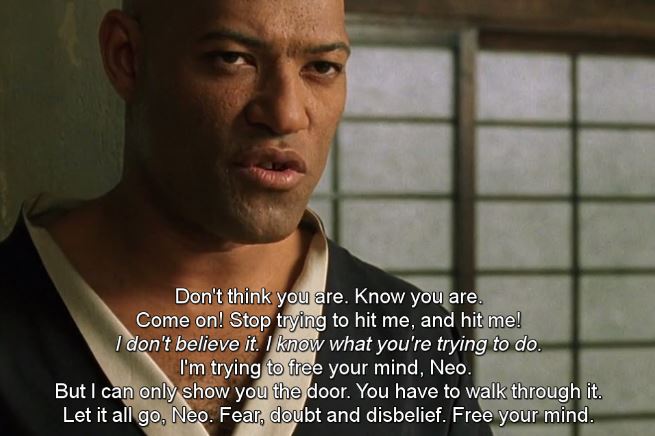
Another meme-worthy formulation of this is "Don't think you are. Know you are" from The Matrix. In other words, don't think you know what will happen if you make a critical move, make the effort to know what will happen. This requires laziness to be banished and increased focus and energy applied. Fear and doubt can enter into the process as well, either when attacking or defending in a critical situation. It's better to put those things aside and focus on determining the reality of what will work and what will not.

Consistent application of a routine thinking process that involves blunder checking and looking at your opponent's resources is also part of this idea, of not being lazy. It's been too easy for me to over-focus on my own possibilities and then, unless I force myself to ask "what are my opponent's threats and ideas", get caught out by something unexpected.

Another aspect of laziness is stopping prematurely when reaching a key future position during calculations. This is normally a result of either dismissing a position as not being viable, when in fact it is, or the opposite problem, which is believing that the position is won/good for you, when in fact your opponent can bust the line with their next move. This means that you have stopped "one move short" of what should be done. Eliminating this problem is not easy, because of the inherently difficult nature of calculating and visualizing multiple potential future positions, but identifying when to make the extra effort and then applying it can go a long way to improving quality of play and your results.

09 October 2020

Using tactics training to strengthen your thought process

Chess tactics training and practice is necessary at all levels; even master-level players will often do problem sets as a warm-up before tournaments. When a player is in the process of gaining strength during their chess studies, the main purpose of learning tactics is to progressively unlock different possibilities on the chessboard. This includes:

  • Recognizing common and uncommon mating patterns
  • Fundamental tactical ideas, such as double attacks/forks, pins, bank rank vulnerabilities, and common sacrificial themes
  • Employing more advanced concepts, such as deflections, clearance sacrifices, the power of intermediate moves in a sequence, and forcing your opponent into zugzwang
Tactics training therefore feeds the pattern recognition process, which is a largely unconscious cognitive function, along with the mostly conscious and effortful process of calculation. (Temposchlucker's posts on "System 1" and "System 2" provide a number of illustrations.) Because of the complexity of chess, in most games we cannot simply remember what to do in a particular position. We can nonetheless recognize similar elements leading to tactical opportunities: poor king safety, hanging pieces, controlled files and diagonals, etc. The more we understand how these elements interact, the more detailed our "automatic" pattern recognition becomes and the easier it is to find specific tactics over the board.

The tactics training process is a necessary but not sufficient condition for gaining additional chess strength, however, past a certain point. Fundamentally, this is because the majority of positions we encounter in a game cannot be "solved" in the sense of there being a forced line leading to mate or material advantage. In many cases there is also no consensus even among professionals on the "best" positional move, as handily illustrated by the "Beat the Masters" series at The Abysmal Depths of Chess blog. This means we have to employ a more general thinking process when actually playing, as opposed to when doing dedicated tactics drills.

From longtime observation of the chess improvement community, it seems that bridging the gap between tactical problem solving and general chess thinking is one of the main hurdles in sustained chess improvement. This is especially the case in adult improvers, who tend to learn by applying systemic thought processes, rather than by intuitive mimicking of whatever works in a particular situation. This parallels how adults learn languages and other complex skills versus how children do it.

The problem is that chess contains both tactical and non-tactical positions, which have different "solutions" and therefore require different mental approaches. Or do they? Naturally it would be best to have a general thought process which takes into account all types of situations. The simplified thought process I generated and its companion, what to think about on your opponent's time, have held up pretty well for me - when I have the energy and focus to appropriately apply the principles. (Energy management in chess is another subject that is worth addressing in more depth.) One of the early positive results of having a more explicit thought process, I found, was to measurably boost my tactics puzzle ratings. This was a positive sign that I was on the right track.

Lately I have more consciously applied general thought process principles to tactics puzzles, most of which are drawn from real games, finding that it has helped both the tactics results and to reinforce the positive evolution of the thought process itself. Specifically, one of the main weaknesses I have identified in my play is an inconsistent recognition of my opponent's resources and threats. This is a common phenomenon among chessplayers, who naturally focus on their own possibilities, and is currently one of the top things holding me back in the middlegame. (Materialism is now less of an issue.)

Beginning each tactics puzzle with the question "What are my opponent's threats?" and identifying all of them has been a simple but helpful change in this regard. "What does my opponent want to do with their last move?" is a related question, also helpful in identifying their strategic plans. In the context of tactics training, you are not likely to be looking for strategically good or prophylactic moves - unfortunately, since that is a major element of gaining chess strength - but identifying threats to your position is always necessary. (Calculating your mate in three is not helpful if your opponent threatens a mate in two, in other words.)

Building the habit of looking at the opponent's moves first as part of tactics training may seem like a simple enough concept, but I expect it will have more profound effects on my general thought process as well. As with all good habits, with repetition comes improvement and greater automaticity, requiring less energy to consciously manage the thought process.

05 August 2012

The importance of CCT: example #1 - Biel round 1

When constructing a practical thinking process, I used as a centerpiece Checks, Captures and Threats (CCT).  This simple idea - beginning any search for candidate moves with these three categories of forcing moves, in the order presented - in fact can have a huge impact on your ability to find "hidden" or non-obvious move possibilities in a position.  CCT should therefore be applied both to identifying your opponent's possible threats (ideally right after he/she moves) and to your own candidate move selection.  The previous linked post goes into more detail on the overall thinking process, for those interested.

Of course, a thinking process is only effective if it's actually used.  Some of my recent games have reinforced this fact to me, as it's all too easy to fall back into bad old habits of only actively considering "natural" appearing moves and not looking past things like "obvious recaptures" as occurred in Annotated Game #57.  Breaking old (bad) habits is only possible by constructing new (good) ones to replace them, so I'm making an effort to consciously apply the thinking process and especially CCT.  Missing good opportunities for onself (or an opponent's threats) is otherwise all too easy.

Being dismissive of the need, or simply being too mentally lazy to apply CCT, has been an issue for me in the past.  One of the ways I'm trying to combat this tendency is by selecting professional examples of where the use of CCT would have changed the outcome of a game.  It's also a useful reminder for the improving player that sometimes failure does not mean you are doomed to chess purgatory forever; even the top levels of professional chess are susceptible periodically to making these types of errors.

The first example is the following game from round 1 of the recently-completed Super-GM level Biel tournament.  Watch what happens on move 33, when it becomes obvious that neither Morozevich nor Giri had done the first C in CCT.  Morozevich would have immediately obtained a winning advantage by playing the only check available to him on the board, had he considered the move.

[Event "45th Biel GM"] [Site "Biel SUI"] [Date "2012.07.23"] [Round "1"] [White "Morozevich, A."] [Black "Giri, A."] [Result "0-1"] [ECO "D97"] [WhiteElo "2770"] [BlackElo "2696"] [PlyCount "101"] [EventDate "2012.07.23"] 1. d4 Nf6 2. c4 g6 3. Nc3 d5 4. Nf3 Bg7 5. Qb3 dxc4 6. Qxc4 O-O 7. e4 Be6 8. Qb5 Bd7 9. Qc5 b6 10. Qg5 c5 11. dxc5 Bc6 12. Qh4 bxc5 13. Be2 e6 14. Bg5 h6 15. Bxh6 Nxe4 16. Qf4 Nxc3 17. Bxg7 Kxg7 18. bxc3 Qf6 19. Qe3 Nd7 20. O-O Rab8 21. Rfd1 Rfd8 22. h3 Bd5 23. a4 a5 24. Rab1 Bb3 25. Rd6 Bxa4 26. Ra1 Qe7 27. Ra6 Bb5 28. Bxb5 Rxb5 29. Ra7 Rdb8 30. Ne5 R8b7 31. Rxb7 Rxb7 32. Rxa5 Qd6 33. f4 (33. Qh6%2B Kxh6 (33... Kg8 34. Qh8%2B Kxh8 35. Nxf7%2B) (33... Kf6 34. Qf4%2B Ke7 35. Qxf7%2B) 34. Nxf7%2B) 33... Rb1%2B 34. Kh2 Nxe5 35. fxe5 Qd1 36. Qf2 Qh1%2B 37. Kg3 Rf1 38. Qxc5 Rd1 39. Qe3 Qf1 40. Kh2 Re1 41. Qd2 Qg1%2B 42. Kg3 Re3%2B 43. Kf4 g5%2B 44. Kg4 Kh6 45. Ra4 Rxe5 46. h4 f6 47. Kf3 Qh2 48. hxg5%2B fxg5 49. Re4 Rf5%2B 50. Ke3 Qg3%2B 51. Kd4 0-1" />

24 December 2012

Analyzing your own games is more than just analyzing your own games

Game analysis is one of those areas which seems to be an obvious necessity for an improving player.  Yet, there is a fair amount of conflicting advice in the chess community on the topic.  Here I want to cut through this and present a practical guide to the benefits of analyzing your own games.  In fact, one can make a strong argument for making this the guiding principle behind your chess study process.

I credit IM Jesper Hall's Chess Training for Budding Champions (Gambit, 2001) for bringing this idea to my attention in a focused, meaningful way.  After a short introductory chapter, the book's second chapter - "I Am Lucky to Have Made So Many Mistakes" - makes the point (based on a short anecdote about a visit to IM Johan Hellsten) that "in your own games, you have all that you need to train with."  The author's reformulation of this is in the first section, entitled "In Your Own Games, There is Everything You Need to Improve."  Why is that?
When you think about analysing your own games, it becomes clear how logical it is that this is the most important and natural way of training.  You are personally involved, you have a deep understanding of the position as you have played the game yourself...This gives depth, but also an insight in to the process of thinking during the playing situation.  That insight is impossible to obtain when you study games by other players.  I therefore recommend that you try to describe, with words, how you thought during the game, mixed with more objective analysis.  Then it will be easier to see what you misjudged during the game.  This is a perfect ground for your training as all aspects of chess are included, even your weaknesses.  With the games as a starting point, you can plan your training and add the knowledge that you lack.
In the same vein, here's a relevant quote from GM Alex Yermolinsky's The Road To Chess Improvement (Gambit 1999), an excellent book which I think I should read again, now that my own chess philosophy and practice has changed considerably.
The problem I had to acknowledge was the stagnation of my development.  I was simply going nowhere.  It's not that I lacked experience - I was 28 years old then, and I had been playing chess for some 20 years up to that point - it was a rather sad realization that my game was not improving.  In search for inspiration I decided to follow the most common advice one can find in the works of Alekhine (my favorite player) and Botvinnik (one of my least favorite ones) which can be put into simple words - study your games.  Ever since, every game I played has been extensively annotated.
Did I follow this excellent advice after first reading these books?  I did not.  Like many chessplayers, I preferred to look for easier ways to improve my chess knowledge than working through my games, many of which were painful losses.  Also, it seemed to me that analyzing my own games would be highly inferior to looking at master-level games, or following master-level advice.

This idea - that your games are of low quality and not worth studying - is one of the main objections or criticisms of the self-analysis process.  However, it ignores the one thing in common for all improving players: you have to do the work and you will be the one sitting down at the chessboard your next game - not someone else.  There are a number of implications to this.
  • In the opening, your understanding of its key positional features - including tactical possibilities - is what will get you to a good middlegame position, regardless of whether your opponent follows your "book" lines.
  • In the middlegame, your thinking process and ability to evaluate different candidate moves, along with spotting opportunities and threats, is what will determine your quality of play.
  • In different types of endgames, recognition of the relevant strategic concepts and positional evaluations will allow you to win (or avoid losing).
In Game Analysis for Improvement in Play I described the practical methods I use for analyzing and annotating a game in approximately two hours.  From a conceptual standpoint, I think the main points to get out of analyzing a game are:
The key point in all of this is that you are the one who has to make all the decisions at the chessboard from move 1.  You have to put it all together and understand what is in front of you.  The best guide to how you will play in the future is therefore how you have played in the past.  For improving players, it comes down to the simple fact that if you can't fix your own mistakes or recognize important gaps in your knowledge, you will not get any better.  No one can be perfect, but recognizing the truth about our own play, however painful it may be, is the first step on the road to improvement (as Yermolinsky noted).  Perhaps the most important realization I have had as part of the game analysis process is that I had failed to use a coherent thinking process in my tournament games.  This realization then resulted in the Simplified Thought Process (That Works).

Analyzing your own games also offers a near-infinite number of ways to improve your chess.  With a database program (free or otherwise), you can explore and analyze how other games in your chosen openings have turned out, focusing on key variations and decision points, and identify model master-level games for further study.  With a chessplaying program, you can take key middlegame and endgame positions that you've identified in your analysis and play them out.  If you've determined that you lack some specific knowledge that is holding you back from better results, you can find books, videos or other tools to address that.  Naturally, this is where chess trainers can come into the picture as well; good ones will look to use your own games as a guide for your training.  In any event, let your own games be the practical guide to what you need to accomplish most.

Below are some resources (some of which have been cited above) for those looking for methods or examples of how analyzing your games can be beneficial.  If anyone has had particularly good (or bad) experiences with other resources, comments are welcome.

Books:
This blog:
Other sites:
  • Study Your Games by GM Nigel Davies at chessville.com
  • 10 Tips for Analysing Your Chess Games at roman-chess
  • Professional players may offer services that involve analyzing and reviewing your games.  Ones I have run across references to include GM Nigel Davies and IM Yelena Dembo, although there are many others out there.
  • Over at chess.com there's a new series of videos being made by IM David Pruess on "How to Analyze Your Own Games" - so far it's up to an intermediate-level introduction.  It's behind the paywall, though, so you will need to be a subscriber to watch more than the first two minutes.

22 October 2011

Chess Performance Inventory

I've decided that it's worth the time to take stock of where I am regarding my chess performance.  I considered calling this a "skills inventory", which would be mostly correct, but I think some of the below categories (particularly tenacity) don't reflect what we would normally call a skill.  I also think that calling this a "performance inventory" is a useful approach, as it inherently makes the distinction between skill level (which is objectively demonstrated during play) and knowledge level (which is not necessarily manifested during play).

It's worth noting that there are a number of formal self-evaluation tests out there, two of the more popular ones being Igor Khemelnisty's Chess Exam and Training Guide (link is to a review at Wang's Chesshouse), which is comprehensive in nature, and the more narrowly focused Bain Rating Tactics Quiz at chesscafe.com.  While I may at some point tackle one or both as an improvement tool, by this point in my chess career I have a good insight into my performance strengths and weaknesses, in part stemming from recent analysis of both my historical and contemporary play (covered in Annotated Games #1-15 as of this post).

I give an overall grade in each of the below categories, with explanations and narratives that are designed to help guide subsequent training.  The grade is based on the standard A through F scale, with F being 59/100 or below.  In practical terms, an A (95/100) implies that there is little or no need for improvement, while the grades below that increasingly reflect either a significant performance gap between skill and knowledge level in the category, or simply a lack of knowledge.  For each category, I also give intended improvement steps ("Way Forward").  The first three categories look at performance during the traditional phases of a chess game (opening/middlegame/endgame), while the last three cover concepts that are more functional or universal in nature and tend to affect all phases of the game.

Opening:  B
This category covers openings selection and the evolution of an opening repertoire.  The criteria for openings effectiveness I discussed more at length in the latter post, but for me the essential, objective test is whether a player consistently is able to use their opening knowledge and understanding to reach favorable (or at least equal) middlegame positions against opposition of any strength.

This is one of my relative strengths as a player, with two solid, tested defenses against 1.e4 and 1.d4 (Caro-Kann and Slav) which also can answer almost any alternative setup by White.  The English opening (1. c4) as White has also been an effective weapon against players of all levels, although not one which is likely to score quick wins.  I have little experience or preparation in some of the more offbeat Queen Pawn openings, probably the largest hole in my repertoire.  With some English lines I also have very little practical familiarity, due to their lack of use by my opponents to date.

Way Forward:  Continue to analyze my historical and contemporary games; examine little-used but major theoretical lines and transpositional possibilities more closely in the English; play additional training games to highlight holes in the repertoire; complete initial study of the Dutch Defense; review selected repertoire lines in the database to improve memory and position recognition.


Middlegame:  C
This phase of the game covers a lot of chess skill area and is generally not fully defined, but the two major subcategories I will address here are:
  • Strategic planning and evaluation.  This involves recognition of key positional factors, understanding of the typical plans available in different position-types, and knowing when to focus on attack or defense.  Here there is definitely a performance gap, as I am better able to understand a position analytically than to conceive and execute a fully correct plan.  This is also reflected in a tendency to have an advantage out of the opening phase, but then mishandle it into a more equal or even losing position; Annotated Game #15 is an excellent contemporary example.  One also needs to be aware of more sophisticated concepts such as prophylaxis, which I apply inconsistently.  My attacking play is also relatively weak.
  • Tactical sight and calculation.  This refers to being able to see the tactical possibilities for both sides in a position and then calculate the resulting sequences (whether forced or not).  For some reason I have historically been weaker at visualizing counting sequences (i.e. when a series of material exchanges occur), so that is a needed area of improvement.  Board sight, including the problem of tunnel vision (focusing only on one area of the board), is also a recurring issue.  I am now much better acquainted with typical tactical and combinational ideas than when I began this blog, but still need further exposure to them.  
Way Forward:  Play more training games; continue working through The Art of Attack in Chess; continue regular practice with the Chess Tactics Server; continue reviewing annotated games from various sources.


Endgame:  F
Pretty self-explanatory score.  I have given very little study to the endgame, so this is the one area where there is no performance gap; I simply lack the requisite knowledge.  I would give myself a "high" F since I know some basic ideas, especially from K+P endings, and some other fundamental concepts - for example, that piece activity is the most important thing in rook endings - but 50/100 is still failing.  It's interesting to observe that this weakness has not had a major impact on past tournament performance, since almost all of my opposition has been nearly as bad in this category.  However, relying on performance that is only good in relation to similarly poor opposition ("grading on a curve") is not helpful to longer-term improvement.

Way Forward:  Once current opening and middlegame books are completed, start introductory endings book.


Thinking process:  D
This is the first of the "universal" categories and is often considered to be bound up with tactics, but it of course literally affects every move we make.  There are plenty of cases of people thinking for 10-15 minutes in the first few moves, for example, when they are uncertain of which opening to pursue or if an opponent takes them immediately out of their opening knowledge.

There are various different thinking processes described in the chess literature and blogosphere, often passionately argued over.  Here I'll focus on three sub-categories which should cover most of the substance necessary:
  • Candidate moves.  Can I see all of the reasonable candidate moves in a position?  Can I narrow them down efficiently for calculation purposes?  When do I calculate one more deeply?  Having too narrow a focus in the candidate move selection process is a traditional weakness of mine, although computer-assisted game analysis and annotation is helping address this. 
  • Falsifying moves.  This is closely allied to tactical sight and calculation ability, but does require additional thought and focus.  For those unfamiliar with the concept, it refers to the process (not unlike the scientific method of attempting to disprove hypotheses) of attempting to refute your selected move.  This involves seeing your opponent's potential threats in the current position and in the future positions that would result from your move.  A basic example is that your opponent has a mate in one threat on your back rank, which would falsify any move that did not protect against it.  This is a new concept for me and better incorporating it will go far toward addressing my failure to see and calculate my opponent's threats.
  • Consistency.  Thinking well on half of my moves is not enough, it must be done on all of them, at least to the minimum standard of reviewing my opponent's possible threats in a position.  This is probably the most simple idea in this category, but also one of the most difficult to apply in practice, due to the ups and downs of a game that have a psychological impact.  I am not consistent in my thinking process.
Way Forward:  Play more training games; institute a minimum baseline thinking process on all moves ("checks, captures, threats"); consciously broaden search for candidate moves prior to determining which should be calculated; aggressively attempt to falsify each candidate move being calculated.


Time management:  A
This is the only category for me where there is no improvement needed.  I almost never have entered into unilateral time trouble (i.e. when the opponent still has significantly more time on their clock) and very rarely end up in mutual time trouble, for example in the last few moves of a time control.  (I tend not to think of the latter as a time management issue, as a player should theoretically use up nearly all of their time before a time control, in order to maximize their thinking.)  My relative strength in the opening phase has greatly helped in this regard, since as a result I normally have a significant amount of extra time to think during the middlegame, where I perhaps play somewhat slower than average.


Tenacity: C
This is something of a wildcard category, but nonetheless a very important one for performance purposes.  (See Braden Bournival's player profiles for another example of its use.)  How many times have we been hit by an unexpected move from our opponents that completely throws us off our game?  When a winning advantage is lost, it is also very common for the player on the downswing to make additional unnecessary mistakes and end up losing; see Annotated Game #13 for an example of this.  This kind of psychological effect is not limited to chess, as momentum and a positive/confident outlook (or its opposite) are powerful forces in other team and individual sports.  I would also put into this category a player's willingness to play a game out to the end, rather than take an easy draw while they believe they still have an advantage.

I can't think of another factor which so greatly affects our final win/loss results, but has nothing to do with our base chessplaying skills.  (Our overall health - both physical and mental - is of course also very important, as if we have the flu or are dealing with major personal problems, our ability to concentrate on a chessboard will be impacted.)  Some of my recent Chessmaster training games helped me understand how a lack of tenacity was affecting my results.  It was eye-opening to see that the majority of times that I blundered while having an advantage, I was in fact still at least objectively equal in the resulting position.  However, in one case I resigned outright, while in several others went down the slippery psychological slope and lost afterwards.  Since then, in training games I have gritted my teeth and refused to go down easy, with improved results to show for it.

Way Forward:  Mentally resolve before a game starts that I will not give up or panic after a blunder or an unexpected move by the opponent; do not accept easy draws when possessing an advantage.

20 August 2011

Game Analysis for Improvement in Play

An earlier post described my general conception of how game analysis can be used as a method of improving play.  Essentially, the focus is put on one's own games and the lessons drawn from them can then be followed up on most effectively.

So far, while I've certainly benefited by re-examining the openings, tactics and strategies on display in each game, the most significant impact for me, interestingly, has been on the thinking side.  I am being repeatedly exposed to alternative moves that I either could not find or did not originally evaluate properly.  Since I know my own thinking process, this type of analysis has had a direct consequence regarding how I now consider each position in front of me, opening up more possibilities and not limiting me to my self-identified "playing style" or "natural" inclinations.  While I do believe that the concept of a playing style is valid and observable, I am more inclined to reject it as an excuse for choosing obviously inferior moves that do not take advantage of the position.

More specifically, here is a description of the method I've been using for analysis of past games:
  • They were all initially analyzed, shortly after being played, as a complete game by Fritz on a reasonable time setting (usually 60s/move). This process catches all of the major tactical ideas and offers some insight into alternative moves beyond simply checking for blunders.  
  • The setting for changes in position evaluation (the "threshold" option under complete game analysis) was usually set to 20 centipawns (in other words +/- 0.2 in a numerical positional evaluation).  This is enough of a swing in the position to be worth flagging, while cutting out a lot of what for humans would be meaningless differences.
  • The game is loaded into a database program, with Houdini running as the analysis engine.  I also bring up my current personal openings book database so I can compare it to the game.
  • I review the game move-by-move.  In the opening phase, I look at the choices made, the implications of alternative choices to the main lines (especially moves by my opponent that are not in my openings book), and evaluate the positional characteristics arising from them.  (This is a fancy way of saying whether I like the position or not.)  The engine is used only infrequently in this part of the game analysis.  This phase helps reinforce and refine my opening knowledge and exposes me to new ideas and areas to explore.
  • The main part of the game (i.e. when it no longer follows a database game) is devoted to looking at the ideas contained in game positions and investigating alternative moves.  These alternative moves are considered based on the original Fritz and current Houdini analysis functions.  I have Houdini set to display its current top three alternatives in a position, which offers a good amount of variety.  Alternatives are looked at critically and in order to understand their tactical and strategic ideas, rather than attempting to always find the "best move" and slavishly following engine recommendations.
  • The game score is annotated with more detailed commentary on individual move alternatives and key variations, while thoughts on the overall course of the game and its significant lessons are then captured, in this case in an introductory blog post.
This analysis process takes roughly two hours per game for me.  I consider this a reasonable amount of time to spend, especially since the focus is on improving my play, rather than achieving a mastery of deep annotations.

As a final note, there has been a fair amount written publicly on the use of computer analysis by players looking to improve their level of play, a good portion of it negative.  My experience has been that computer-assisted analysis is quite valuable and productive, with a great deal of return on the time invested.  One still has to do one's own thinking; that said, having engines point out alternatives, which can then be analyzed and understood, has for me resulted in an improved thinking process.

14 October 2025

(Updated) game analysis for improvement in play

Game analysis setup with CB18

At the start of this blog, which coincided with a new phase of more serious (and continuing) chess improvement efforts, analyzing your own games was identified as the necessary heart of an improvement strategy. This continues to be the central driver of the process for me, which is essentially an ongoing cycle of self-diagnosing issues with my game, then investigating and applying the chess knowledge gained as a result.

There are multiple guides on doing your own game analysis out there that may be helpful - although I've found some of them lacking sufficient detail on the "how" part of it, or sometimes recommending particular procedures that I don't find practical for my own purposes. Since the methods (and some of the tools) I've used have shifted a bit since "Game Analysis For Improvement in Play" was originally published, I thought it would be worth providing an updated analysis methodology outline. Caveat: this is not necessarily a template that will work best for everyone's practice, or that should be followed 100%. Rather, the intent is to provide a example of practical study methods in action. (I am a big proponent of the "whatever works for you" school of training, covered in more detail in "Do study techniques matter in chess?")

Some core tools are required for any setup: databases (at minimum one with your games, paired with a large reference database for comparison); an analysis program/GUI; and a top-class engine. Widely available options, both commercial and free, are covered in detail in the Chess Computing Resources (2021) post. Despite the age of it, the relevant links still work, and you just need to make sure to get the latest versions of the products; some of the main computing resources are also permanently linked in the sidebar. (For reference, my current analysis setup is displayed up top: ChessBase 18 running with the Dragon 3.2 engine and Annotated Game #323 displayed.)

Here's a description of my current step-by-step process, which typically takes around two hours for a fully annotated game:

  • The game is entered into the database; I have one for all of my tournament games and a separate one for training games. If you are playing online at Chess.com, lichess.org or other sites, normally you can simply download a pgn file of your game and copy that into your database. For OTB games, naturally you'll have to enter it manually via your analysis program GUI - unless you're part of the elite where you play on an electronic board that records all your moves in the cloud. 
  • During a tournament, I will make sure to enter all the games into the database before it is over. However, this will not necessarily happen on the same day they were played, if I'm too tired. Because it would be too much of a time and energy suck, I won't do a full analysis of my games while the tournament is ongoing, but I will normally take a quick pass through them with an engine running in order to validate (or refute) my understanding of what just happened in them. (For example, I would feel stupid to get caught out by the same error twice in a tournament.)
  • During the initial manual entry of moves, or as a first pass during the analysis process if the full game notation is already copied, I capture my thinking process on significant moves in text comments. This could start as early as move 1, if the opening selection choice is worth mentioning, or it could start at the end of a typical main line sequence. In any case, I don't worry about polishing the language for publication, since it is more important to first record the thought process (whether accurate or flawed) and any other significant considerations at the time (physical or emotional stress, time trouble, etc.) that may have affected decision-making. This is also a good time to record other candidate moves that you considered, along with any related commentary and/or sample variations.
  • During a full analysis session, I review the game from the beginning move-by-move with a reference database and engine running. Normally I will also have my opening repertoire database up in a separate window, so I can refresh my memory of the relevant opening line and note any deviations made by myself or my opponent. Here is where I will also investigate any new moves in the opening - new to me, at least - and update my repertoire database as needed. Considerations at this stage include the move's score percentage in the reference database, combined with the engine's evaluation and my own understanding and preferences in the opening line we are following. It is often useful to review some of the master-level games in the database that continue in the line being examined, to get a better idea of resulting middlegame positions and plans.
  • After the "book" opening phase is past, the analysis process is devoted to examining and validating (or refuting) the actual moves played in the game, comparing them with the engine's and database's top other moves (for as long as the database has identical games). I normally have the top 4 engine moves displayed for variety, to get an idea of what good candidate moves are available in the position. Key variations are identified, understood (important!) and entered into the commentary, including alternative viable strategic plans and any tactical opportunities/threats overlooked (sometimes by both players). During this process, while the engine serves as an excellent reference, it is very important to avoid simply taking the top engine line for granted as "best" in a position. This is something which especially should not be done if you do not understand the moves it recommends. ("Pitfalls of Computer Analysis" goes into more detail regarding the practical considerations of using an engine for analysis.)

It was surprising to me how much rich content could be derived from just one reasonably thorough analysis of a tournament game. Especially when done regularly and in a timely fashion - something I have not always been the best at - it also inevitably highlights meta-trends in your performance. For me, that has included the recognition of a lack of a consistent thinking process, recurring flawed moves in a particular opening, or a repeated failure to maximize piece activity. Perceiving and rectifying these types of bigger problems with your game, not just identifying individual blunders that are made, can represent a major investment and payoff in long-term improvement potential. Sometimes, of course, positive trends in our game are also highlighted; it's especially important to recognize and celebrate when your mental toughness helps you draw (or even win) a lost position.

Some other typical training benefits I've observed, after employing the above methods:

  • Openings: playing, then reviewing and analyzing what occurred in the chosen opening, has been the most effective way for me to understand more deeply and then remember opening lines for future use. This process also naturally results in the refinement of your repertoire based on new information and the practical challenges being encountered in your chosen lines at the board; there really is no better feedback loop.
  • Tactics (and not just for the middlegame): what tactics were completely missed? Seen but miscalculated? Visualized improperly? Recurring patterns such as missing the idea of potential backwards piece moves, not visualizing discovered attacks that appear after several moves of calculation, etc. are in fact common phenomena. Although we cannot completely eliminate them, being more consciously aware of these issues in your games and mentally calling them out can help us overcome these blind spots.
  • Candidate moves: in both the middlegame and endgame, the number of different types of candidate moves considered (both positional and tactical) has expanded significantly for me. Other than highlighting specific forced wins or clear blunders, this I believe is the most important function of engine assistance in analysis: showing the player possibilities that they would not otherwise have considered (either at the time, or during unassisted analysis).
As mentioned above, I believe the exact methods used are probably not as important as the fact game analysis is consistently occurring at the effortful study level for a player. In fact, I think it would actually be rather difficult to avoid improving your game as part of this process, if it is done regularly and you deliberately follow up on what you discover with both curiosity and a positive intent to apply the lessons learned.

30 April 2017

Annotated Game #174: Choke

For those not familiar with the word "choke", it refers in English slang to when an individual sportsperson (or sometimes an entire team) is presented with a clear winning opportunity during an important moment, but instead they screw it up and lose.  This next tournament game is a great example of this phenomenon.  After three wins in a row I was paired against the leader of the section and had a chance to move into first place with one round left to play.  Instead, after doing well in an aggressive English Opening (yes, the English can be aggressive), I was one move away from victory, but instead had a major thinking process failure on move 24 (trapping my opponent's queen...except for the one move that beat me).  It had been a rather exciting and somewhat exhausting game up until that point, so even though it was relatively early on move-wise, I had expended a good amount of clock time and a lot of mental energy on calculating variations since the unexpected 17th move from my opponent.  Basically I lost patience and decided to skip the process...with unfortunate consequences.  Lesson learned.

[Event "?"] [Site "?"] [Date "????.??.??"] [Round "?"] [White "ChessAdmin"] [Black "Class C"] [Result "0-1"] [ECO "A13"] [Annotator "ChessAdmin/Komodo 8"] [PlyCount "56"] [EventDate "2016.10.10"] [EventType "schev"] [EventRounds "5"] {[%mdl 8192] A13: English Opening: 1...e6} 1. c4 e6 2. Nf3 d5 3. e3 Nf6 4. b3 Be7 {now in a standard QGD type setup for Black.} 5. Bb2 Nbd7 6. Be2 b6 7. O-O Bb7 8. Nc3 (8. d3 {is an option, with the idea of Nbd2.}) (8. cxd5 $5 { immediately is more common than the text move.}) 8... O-O 9. cxd5 {this seemed the logical follow-up. I've previously had bad experiences with Black building a strong pawn center and this takes care of that problem.} Nxd5 (9... exd5 10. Rc1 Re8 11. Qc2 Bf8 12. Rfd1 c6 13. d4 Bd6 14. Bd3 Qe7 15. Ne2 g6 16. Ng3 Ng4 17. Re1 f5 18. Bxf5 gxf5 19. Nxf5 Qf8 20. e4 Bf4 21. e5 Re6 22. Rcd1 Kh8 23. g3 Qg8 24. Kh1 {Gunina,V (2529)-Kriebel,T (2461) Novy Bor 2015 1/2-1/2 (157)}) 10. Rc1 (10. Nxd5 {is more common. The Nc3 isn't a great piece and it's better to exchange it, also opening up the long diagonal for the Bb2 (and the c-file for a rook).} Bxd5 11. Qc2 c5 12. Rad1 Rc8 13. Qb1 Qc7 14. d4 Qb7 15. Rc1 cxd4 16. Bxd4 Bf6 17. Qb2 Bxd4 18. Qxd4 Nf6 19. h3 h6 20. Qa4 a5 21. Qd4 Rc7 22. Qe5 Rfc8 23. Ba6 {1-0 (23) Alekseev,E (2679)-Rusanov,M (2440) St Petersburg 2014}) 10... Bf6 11. d4 {here I decided the benefits of the pawn advance outweighed shutting off the Bb2. First of all, Black's Bf6 is also shut out, and I also get a strong central pawn that influences e5 and c5. The a3-f8 diagonal also looks like a good one for my bishop.} Rc8 $146 {a slow move and one that allows the following sequence, giving me a measurable edge.} (11... Nxc3 12. Bxc3 c5 $11) 12. Nxd5 $14 Bxd5 (12... exd5 13. Ne5 Nxe5 14. dxe5 Be7 15. Bg4 Ra8 16. Qc2 c6 17. f4 $14) 13. Ba6 {this is the problem with the earlier rook move, Black loses a tempo and his queenside is looking awkward.} Rb8 14. Bd3 { I had been worried about a possible future ...b5, blocking the bishop in. Another square might have been better, though.} (14. Bb5) (14. Qe2 {is another option the engine likes, controlling the diagonal (and b5) while connecting the rooks and protecting the Bb2, which is otherwise loose.}) 14... c5 { the logical reaction by Black, taking advantage of the unprotected Bb2 to rule out capture on c5.} 15. Ne5 {a somewhat risky and aggressive decision that was not the best. I didn't mind the exchange on e5, and it is evaluated by the engine as equal.} (15. Qe2 cxd4 16. Nxd4 Rc8 $14) 15... Bxe5 $6 {a case where the standard rule of not exchanging bishops for knights applies.} (15... cxd4 $5 16. exd4 Nxe5 17. dxe5 Be7 $11) (15... Nxe5 16. dxe5 Be7 $11) 16. dxe5 $14 { White has the pair of bishops, but also the Nd7 has no useful squares at the moment.} Qg5 {this surprised me, but I was able to find an effective countermove.} 17. e4 {now I have the initiative.} Bc6 18. f4 {the queen's location becomes a problem for Black.} Qh4 19. Rc2 (19. Rc3 $5 {is probably a better version of the idea of transferring the rook to the kingside (after Bc2) and one that I considered for a while. In the end I rejected a plan of a piece attack on the kingside for one based on a pawn advance.} Qe7) 19... Rbd8 20. g3 (20. Qe2 $16 {getting off the d-file and overprotecting e4 was an excellent idea.}) 20... Qh3 $6 {this over-optimistic move justified my play to this point.} (20... Qe7) 21. Rd2 $16 {screening the Qd1 and protecting the Bd3 again.} f6 $2 {causes even greater problems, in part because the Qh3 now has no safe retreat. It also weakens e6, which I take advantage of (but not well enough).} (21... Nb8 $16 {looks sad, but otherwise Black has serious problems.} ) 22. f5 {I thought for a while here and felt good about the move, which presses the attack, but is rather complicated given the various captures on e5, f5 and e6.} (22. Be2 {is found by the engine the threat being to play Bg4 with a fork on e6.} f5 (22... h5 23. exf6 Bxe4 24. Rf2 gxf6 25. Bxh5 $18) 23. Bc4 Rfe8 24. Rd6 Bxe4 25. Rf2 Qh6 26. Rfd2 $18) 22... Kh8 $2 (22... Qh6 23. Bb1 Qe3+ 24. Rff2 $18) 23. Rf4 $1 {this should be sufficient to win. The threat of course is Rh4, trapping the queen.} Qh6 24. Rh4 $4 {here I moved too quickly and had a major thinking process foul. I had assumed that the queen was trapped, but of course it now has e3 to go to, with devastating effect. This was a case of the actual piece placement (Rf4) interfering with my mental visualization of the future board (Rh4, Qh6), where the diagonal is no longer blocked. Naturally if I had followed my thinking process, I could have corrected for this.} (24. fxe6 $1 {and wins.} fxe5 25. Rxf8+ Nxf8 26. e7 $18 { I had in fact looked at this variation, but was tired and having trouble visualizing. And then it occurred to me (mistakenly) that I could just play Rh4.}) 24... Qe3+ $19 {after this it is game over, although I fight on for a few moves in the vain hope for a swindle.} 25. Kf1 Nxe5 26. Qh5 Qf3+ 27. Ke1 Qxh5 28. Rxh5 Nxd3+ 0-1

20 April 2017

How do you know you are becoming a stronger chess player?


Chess strength is a funny thing.  It's hard to define precisely, so we rely on rating systems (primarily Elo-based) as a proxy statistic for it.  Yet clearly there must be something substantive behind the explanation for why players have particular levels of strength, so we can talk about things like "master" and "expert" versus "Class B" and "Class C" players.  (I am currently a Class B player, per the USCF scale above.)

There are some helpful, if not necessarily definitive, attempts at providing "roadmaps" or the like to chess knowledge at each level.  Here is one posted at Chesstempo.  You can also infer what knowledge is considered standard to have at beginner, intermediate and expert levels from resources such as the Chess.com study plans.  Another approach is defining specific characteristics and skills that set the higher levels apart from others, as done by GM Andy Soltis in What it Takes to Become a Chess Master.  Soltis' book I think gets at some crucial concepts, including how masters are able to much better understand (and apply) things like compensation for sacrificed material in the absence of concrete winning tactics.  This includes "positional" sacrifices of the exchange or a pawn or two, where there is no combination on the board, yet the master understands that in the long term, their chances are better (or at least as good) as before the sacrifice.

All of the above approaches to explaining playing strength have their uses, but one of the conundrums of chess strength is that it often does not reflect the extent of a player's knowledge, at least on a one-to-one basis.  Some things are directly correlated with your ability to win; knowing basic mates and mating patterns are fundamental to success.  Others are helpful, but not 100% required (for example how to play the Philidor and Lucena ending positions).  Finally, some pieces of chess knowledge have a very low (yet non-zero) percentage chance of ever being directly helpful (such as knowing the K+B+N v K mate).  Soltis' work outlining particular crucial areas of skill I think comes closer to a cognitive approach, rather than simply giving a list of "must knows", but of course this approach is necessarily subjective, rather than rigorously scientific.

Similar to Soltis' approach, but on a more practical level for the improving Class player, I'd like to document some phenomena that appear as concrete indicators of improving chess strength.  It's not an exhaustive list, but I think it is useful to share.  I make no claim to having originated any of these ideas, but in reading widely and through analyzing my own games I have been struck by how important some of these are when they appear, and I have personally experienced all of them at one time or another.  Naturally there are many more improvements yet to come...

I've arranged the below phenomena in what seems to me to be a logical progression from ones based on more concrete/tactical/conscious considerations, to those that are more cognitive/strategic/unconscious in nature.  Again, these are meant to be taken as positive signposts you may see on the road to mastery, whenever you observe them in your games.  I think it's important for improving players to explicitly recognize the positives in their game, along with the many errors and negatives, otherwise chess can start becoming toxic and demotivational.  We (including professional players) will always fall short of perfection, but that's to be expected, and therefore not overly lamented.
  • I hesitate to start with this one because of its obviousness, but blunders (making less of them) really is fundamental.  If you keep having the same frequency of game-ending blunders (i.e. losing a piece or overlooking mating threats) over time, then by definition you will make little progress.  Having at least a basic blundercheck thinking process is necessary; over time, it hopefully will become more and more unconscious (but still necessary).  One practical observation I've read before, and tend to agree with based on personal observation, is that by Class B level the majority of games are no longer decided by blunders, and by Class A only a very few are.  In other words, you more often have to beat your opponent, rather than just waiting for them to beat themselves.
  • When analyzing your games, you have an increasing number of "!" annotations.  This is related to the above indicator on blunders (the "?" moves), but it is not simply the elimination of errors, but rather a demonstrable ability to find the key (sometimes only) move that gives you a breakthrough in the position.  You can always give yourself a "!" if you're feeling generous, but it's worth more when coming from an unbiased annotator, which in many cases will mean your computer engine.  Although there are some pitfalls of computer analysis, engines can almost always correctly identify the standout strong moves ("!") as well as the blunders.
  • Something a little less obvious, but a definite sign of improvement in strength and sophistication, is spotting and deliberately using intermediate moves when conceiving and calculating move sequences.  One thing I have seen repeatedly in my game analyses is that I (or my opponent) often may have a good idea, but it is not executed to the full extent of its power, whether it may be a strategic pawn break or a particular tactic that becomes much more effective with the insertion of an intermediate move.  I think that learning how to keep searching for more effective moves after finding a good idea is the key, including taking a particular idea and then looking creatively at the different possibilities of how and when it could be most effectively played.  Annotated Game #171 has some good examples of effective intermediate moves.
  • As part of your evaluation of the position, you start naturally "thinking in squares" rather than just about the pieces and threats to them.  Weak squares in your opponent's camp become magnets for tactical and strategic ideas; one common example is if f2/f7 become underprotected next to a castled king.  Excellent squares should also suggest themselves (see below) for your pieces - for example leading to the repositioning of a knight, perhaps even using a tactic, to get it to a dominating outpost on the opponent's side of the board.  Defending your own weak squares and realizing when they might be created (after a pawn push, when a key piece moves away) is also very important, the more so the higher level you get.  (See this example commentary game.)  Going back to the thinking process, Botvinnik suggested thinking on your opponent's time about positional considerations rather than calculating variations - squares are a big part of this process.
  • Allied to the automatic recognition of "thinking in squares" is the development of a more automatic/unconscious visualization skill, in other words the ability to picture future board positions in your mind.  I have found that this grows naturally in the context of a consistently applied training/study plan, as long as you sometimes move the pieces in your head rather than always on the board.  One good example of doing this is when variations are given in an annotated game and you visualize them, rather than playing them out physically.  This can also be practiced in reading chess books without a board, starting with ones that have plentiful diagrams (such as Logical Chess: Move by Move).  At a basic level, you should not need to have the board coordinates (A-H, 1-8) printed on the board for you to immediately identify a square.  The next stage is being able to mentally picture (away from a board) the color of a particular square (d4 is black, b7 is white, etc.) quickly; if you can't do this, then your internal board sight is not functioning on an unconscious level and the need to process this consciously will slow you down.  Finally, being able to play a game "blindfold" (without sight of the board, whether or not you actually are wearing a blindfold) is more than a parlor trick, it is a sign that you have strong visualization skills that will strengthen your calculation and evaluation of variations.  Blindfold chess skill is again not a one-to-one correspondence with overall chess skill - not everyone can be Timur Gareev and he is not at the super-GM level (yet) - but it is a strong indicator of your general strength level.
  • While the above are largely conscious mental efforts related to the process of calculation - with visualization being, I would argue, also a partially unconscious function - one unconscious-origin phenomenon is when a move "suggests itself" without you doing any calculation at all.  At a certain level this phenomenon is related to what we call "natural moves" - which to a lower strength player do not necessarily appear natural at all.  Geometrically these can typically be defined as when an individual piece can be moved to a square where it will have maximum influence across the board, particularly into the opponent's camp.  More sophisticated versions of this idea occur when we have a mental library of successful positional patterns built up, so we make an instant comparison to what we have seen work before.  To quote Magnus Carlsen: "Of course, analysis can sometimes give more accurate results than intuition but usually it’s just a lot of work. I normally do what my intuition tells me to do. Most of the time spent thinking is just to double-check." 
  • Finally is an observation that I once read by a GM (the source regrettably does not occur to me right now, maybe Yermolinsky?) who noted that when you gain strength you do not in fact feel any stronger yourself; rather, your opponents start seeming weaker (in the same Elo range as you).  This is naturally a largely unconscious impression, but I believe it's a valid one and probably one of the most powerful indicators that you have in fact shifted significantly past a previous milestone in chess strength.

27 April 2020

Functional fixedness

I would say that the #3 thing that holds me back in chess - following the top two things - is functional fixedness. One general definition of this phenomenon is "A mental block against using an object in a new way that is required to solve a problem". In the chess context, this means an inability to see possible moves by pieces beyond their "assumed" current function. Some common examples of this in tactics are:
  • Where one side is able to force a break of a pin (not against the king)
  • Material sacrifices, especially large ones (queen sacrifices tend to be the most surprising)
  • Inserting a key intermediate move in a sequence (for example postponing an "automatic" recapture).
In all cases, these tactics appear because the other side had not considered the move "possible" - even though, of course, the rules of chess say otherwise.

This cognitive fixedness can be a significant problem when coming up with candidate moves and also in the subsequent visualization process while doing calculation. Our brains fundamentally tend to be lazy. (This is in fact a survival trait that cuts down on unneeded energy for processing.) They therefore like to make assumptions, which help simplify whatever task is in front of us to solve. Fighting this tendency requires both a conscious awareness of your cognition - in chess, this means consistently following a suitable thinking process - and enough energy to keep your brain functioning at a high enough level.

It may seem a little backwards, but I've found over time that focusing on energy management has had the biggest payoff in my quality of play. It makes it that much easier to focus and actually implement your thinking process, especially when there is a need to erase previous assumptions in order to uncover the new possibilities in a position. Just looking at two basic questions - 1) What did my opponent's last move change about the position? and 2) What CCT (checks, captures, threats) are available? - can go very far in finding opportunities for both your opponent and yourself.

10 March 2012

Annotated Game #35: Thou Shalt Falsify

Following Annotated Game #34, over a year passed between tournaments.  During this next tournament, I was at a point in my life where I had just moved and was preparing to move again soon for another job.  I also had not been serious about studying chess for a while.  These factors all combined to produce a notably poorer quality of play throughout the tournament.

In this game, the first round of the tournament, as White I get a very pleasant position out of an English Opening; my opening play continued to be effective, at least.  Black enters a dubious variation (a transposition to an Old Indian Defense) and drops a pawn, leading to an unusual middlegame where White has an outside passed pawn early on.  If White had known what plan to follow, this would most likely have led to victory.  However, rather than actively pushing the pawn and exploiting his queenside dominance, I played too passively and had a game-ending thought process mistake on move 19.  The failure to falsify my candidate move (which would have immediately picked up Black's threat to take the Nc3) was a reflection of an unstructured thinking process, something which in fact I've only recently rectified.

[Event "?"] [Site "?"] [Date "????.??.??"] [Round "?"] [White "ChessAdmin"] [Black "Class B"] [Result "0-1"] [ECO "A54"] [Annotator "ChessAdmin/Fritz/Houdini"] [PlyCount "86"] [EventDate "2003.??.??"] {A54: Old Indian Defence with Nf3, but without e4} 1. c4 e5 2. Nc3 Nf6 3. Nf3 d6 4. d4 exd4 5. Nxd4 Be7 6. g3 Bd7 7. Bg2 Nc6 8. O-O Nxd4 {only one game in the database has this.} (8... O-O {is the overwhelming choice here}) 9. Qxd4 $14 {White already has a pleasant game and control of the center, while Black is slightly behind in development and must attend to the threat on the long diagonal.} Rb8 $6 {this simply drops a pawn.} (9... Bc6 $5 {is what the engines like. At first glance} 10. Bxc6+ bxc6 11. b3 {looks a bit ugly for Black with the doubled pawns. However, with the light-square bishop off the board, the c6 pawn is not so weak and it covers the key d5 square.}) 10. Qxa7 $14 {Fritz originally gave White more of a plus here, but Houdini shows about a half-pawn advantage for White. Black has the opportunity to get some initiative for the pawn, but it's not enough compensation in the long run.} Bc6 11. Bxc6+ bxc6 {unusually, White now has a passed a-pawn in the early middlegame. Houdini shows the best plan is to push it for all it's worth, something which I unfortunately neglect to do.} 12. Bg5 {probably not a move I'd choose today. The bishop itself is unprotected and exchanging it for the Nf6 would greatly improve the scope of Black's bishop. If Black simply castled here, he'd be OK. Taking the b-pawn is only a temporary gain for him, however.} (12. a4 $1) 12... Rxb2 $14 13. Rab1 Rxb1 14. Rxb1 O-O 15. Rb7 {the point of the sequence for White.} Ne8 16. Bxe7 {a typical reaction at the amateur level, only looking at the immediate capture.} (16. Rb8 Qd7 17. Bxe7 Qxe7 18. Qa8 { and White is dominant on the queenside and in Black's back rank, with the outside passed pawn waiting in the wings.}) 16... Qxe7 17. Qa4 (17. a4 { passed pawns must be pushed!}) 17... Qe5 18. Qc2 {a passive choice, either b3 or b4 would be a better square.} f6 19. Qe4 $4 {this kind of oversight (leaving the Nc3 hanging) is a thinking process flaw, namely failure to falsify.} Qxc3 $19 20. Qe6+ {the best chance for a swindle, although I'd seen that 21...Qe5 saves Black.} Kh8 21. Rb8 Qe5 22. Qxe5 fxe5 (22... dxe5 $2 { interestingly would have given the game to White, as Black couldn't untangle his pieces in time to stop the a-pawn without losing material.} 23. a4 c5 24. a5 $18 Kg8 25. a6 c6 26. Rc8 Kf7 27. a7 Nc7 28. Rxc7+ Ke6 29. Rxg7) 23. a4 Kg8 24. a5 Nf6 25. Rxf8+ Kxf8 {and now the knight can stop the a-pawn without difficulty. White is lost, as both the a- and c-pawns will inevitably fall (although in the game Black never gets around to taking the a-pawn).} 26. e4 Nd7 27. a6 c5 28. f4 Nb6 29. a7 exf4 30. gxf4 Ke7 31. Kf2 Ke6 32. Kf3 c6 33. h4 g6 34. Kg4 d5 35. e5 Kd7 36. f5 gxf5+ 37. Kxf5 dxc4 38. Kf6 Ke8 39. h5 c3 40. h6 c2 41. Kg7 c1=Q 42. Kxh7 Qg5 43. e6 Qe7+ 0-1

24 November 2012

Annotated Game #71: Mate in Never

Once the 2012 Round Turkey tournament is completed, I'll post analyses of those games.  This time, I'll continue my past tournament game analysis with this heartbreaker.

Following the relative success in Annotated Game #70 against a higher-rated opponent, in the next round of the quad tournament I faced another Class A player.  My opponent employed an offbeat defense as Black, starting with a queenside fianchetto; see Annotated Game #30 for a similar start.  Although White could have made some early improvements in play, he gets a favorable position out of the opening.  By move 11 there is an opposite-sides castling situation, which even without queens on the board can be dangerous for the player (in this case Black) with a weaker king position.

The course of the rest of the game demonstrates how weak my thinking process was at the time and the dangers of passive play once a winning advantage has been obtained.  Black in the middlegame ignores White's potential threats down the half-open c-file, which eventually are realized on move 22.  Breaking into Black's king position, White misses a mate in 3 on move 26 - a shocking rook sacrifice to shut off the king's escape - but nevertheless emerges with a comfortable winning material advantage.  Here is where things start going wrong, ironically.

Black refuses to go quietly and instead plays the most threatening moves possible, which is the best (and usually only) way to aim for a swindle.  White's key mistake is on move 35, where instead of calmly taking Black's h-pawn, he backs his king into h1. Objectively he is still fine, but the conditions for the swindle have now been created.

Black's immediate next move gives White a mate in 2.  I recall thinking hard about the position, knowing that there must be a winning possibility, but I was simply unable to see it.  The psychological pressure - all self-inflicted - simply got to me.  This is also another example of the importance of CCT (checks, captures and threats) in the thinking process.  The failure to see the mate is also symptomatic of a more general weakness of mine in visualizing mating nets.  I've gotten better at it, especially in the last year, but it's still an area for improvement.  The ratings gap (around 300 points) also contributed greatly to the psychological pressure; I've subsequently learned to put aside ratings fear and instead treat it as an opportunity.

The remainder of the game - still won for White up until move 43 - is a classic example of the winning side making a series of passive moves and failing to calculate the more active ones, for fear of losing.  This is punished effectively by Black, who never stops looking for aggressive continuations and finally traps White's king on the back rank.

I remember that after the game, one of the kibitzers mentioned to me that I had missed a mate.  I told him, feeling somewhat bitter, that I knew that.  Too bad that as it happened, it was a mate in never.

[Event "?"] [Site "?"] [Date "????.??.??"] [Round "?"] [White "ChessAdmin"] [Black "Class A"] [Result "0-1"] [ECO "A10"] [Annotator "ChessAdmin/Fritz/Houdini"] [PlyCount "88"] {A10: English Opening: Unusual Replies for Black} 1. c4 b6 2. Nf3 Bb7 3. g3 Bxf3 4. exf3 d5 $146 {that's right, out of the database on move 4. This can't really be good for Black.} (4... c5 {is overwhlemingly played here.}) 5. Bg2 ({ The obvious} 5. cxd5 Qxd5 6. Nc3 {is also good for White's development.}) 5... dxc4 6. Qa4+ {White is in a bit too much of a hurry to recover the pawn.} (6. f4 {looks strong here, will be necessary at some point anyway, and gains a tempo with the attack on the Ra8.}) 6... Qd7 7. Qxc4 Qc6 8. Na3 (8. d3 { would be the alternative choice to help White's development. I preferred the idea of the central knight placement, however.}) 8... Qxc4 {while the queen exchange simplifies down material, it also leaves Black with weaknesses on the queenside and in the center.} 9. Nxc4 Nd7 10. f4 O-O-O 11. O-O {White has a much better king position, by comparison. Even without the queens on the board, Black has to worry about king safety.} Ngf6 {developing knights before bishops, but ...e6 would have allowed Black to cover b4 with the bishop.} 12. Rd1 (12. b4 {would have taken advantage of Black's failure to play ...e6 by gaining space on the queenside.}) 12... g6 {Black prefers developing his bishop on the long diagonal. This should not be a surprise, considering his first two moves.} 13. Ne5 {this prematurely gives up White's hold on e5; the minor piece exchange also favors Black, since the Nc4 is superior to the Nd7.} Nxe5 14. fxe5 Ng4 $2 {this is tactically unsound due to a pinning theme, which I unfortunately failed to find.} (14... Nd5 {is the logical central spot for the knight, which cannot be chased away by a pawn.} 15. d4 $11) 15. d4 $6 { focusing on the "obvious need" to protect the e5 pawn.} (15. Bh3 {a shame that White overlooked this excellent chance, says Fritz.} h5 16. f3 $18) 15... Nxe5 $11 {the only way to get the knight back in the action. This works due to the hanging Rd1.} 16. Bf4 {White is unfazed by the sacrificed pawn, which allows him some useful initiative.} Nc4 17. Rac1 Nd6 18. a4 $6 (18. Rc2 {sometimes the obvious plan is the best. Black is going to be on the defensive due to the half-open c-file and White's bishops pointing in his direction.} Kb8 19. Rdc1 Rc8 20. Bh3 f5 21. Re1) 18... h5 {with opposite-side castling, the middlegame can be a race to see who gets in their attack first. Black here makes his first aggressive move.} 19. Re1 e6 {this solves Black's immediate problem of freeing the bishop from protecting the e-pawn, but also creates other positional weaknesses.} 20. Be5 {obvious but not best.} (20. a5 {is Houdini's attacking choice. White advanced the pawn already, so why not use it?} bxa5 ( 20... b5 {is assessed as best by Houdini, declining the second pawn.}) 21. Be5 Bh6 22. Ra1 Bd2 23. Re2 Bb4 24. Bxh8 Rxh8 $14) 20... Rg8 (20... Bh6 {as in the above variation would more creatively help solve Black's problems by getting the bishop out.}) 21. Rc6 Bg7 $4 {ignoring White's threats on the c-file.} ( 21... Ne8 $11 {is the defense preferred by the engines, also removing the knight from potential tactics involving the pin of the c-pawn.}) 22. Rec1 $18 { now the doubling of rooks is obvious.} Bxe5 $2 (22... Ne8 23. Bxc7 Rxd4 24. Bxb6+ Kd7 25. Bxa7 Rd3 $18) 23. Rxc7+ (23. dxe5 $6 {is clearly worse} Ne8 $14) 23... Kb8 24. dxe5 Nf5 {this allows a mate in four. Let's see how far White goes along the mating path...} (24... Ne4 {no good, but what else? Says Fritz.} 25. Bxe4 Rd1+ 26. Rxd1 Kxc7 $18) 25. Rb7+ {so far so good...} Ka8 26. Rxb6+ { not leading to mate, but still winning.} (26. Rc8+ $1 {at this point in my career, I would not have even considered this type of tactical, sacrificial move.} Rxc8 27. Rxb6+ Rc6 28. Bxc6#) 26... Rd5 $18 27. Bxd5+ exd5 28. Rbc6 { White emerges an exchange and a pawn up. Unfortunately, Black does not just roll over and die and I start getting careless as a result.} Rg7 29. b4 (29. Rc8+ {and White can already relax, comments Fritz.} Kb7 30. R1c7+ Kb6 31. Rc6+ Ka5 32. Rb8 $18) 29... Nd4 30. Rc8+ Kb7 31. R1c7+ Kb6 32. Kg2 g5 33. Rd7 h4 34. Rxd5 h3+ 35. Kh1 {Although this move still wins in objective analysis, it is the root of White's coming loss, giving the king no escape squares off the back rank.} (35. Kxh3 {was perfectly fine, but I didn't bother calculating it because it superficially looked too dangerous.} g4+ 36. Kg2 $18) 35... Ne6 { this gives White another mating opportunity, this time a mate in 2. An excellent example of where using CCT would have made the difference.} 36. Rd7 ( 36. Rb5+ Ka6 37. Rc6#) 36... g4 $18 37. a5+ (37. Re8 {would have made excellent use of the pinned pawn on f7.} Rg5 38. Ree7) 37... Kb5 38. Rxa7 Rg5 39. Rc1 Rf5 {Black continues to play for a swindle, setting up the most aggressive and threatening continuation possible.} 40. Kg1 (40. Ra8 {the engines aren't afraid of the threat to f2.} Rxf2 41. a6 Ra2 42. Rb8+ Kxa6 43. Ra8+ Kb5 44. Rxa2) 40... Nd4 41. Rb1 {White continues to make passive moves and does not calculate more active possibilities.} (41. Rb7+ Ka4 42. a6 Ne2+ 43. Kf1 Nxc1 44. a7 $18) 41... Nf3+ 42. Kh1 Nd2 43. Rb2 {the careless, losing move.} (43. Rb7+ {again wins, but is not as easy to see here.} Ka6 44. Rb6+ Ka7 45. Rd1 Rxf2 46. Rh6 $18) (43. Rc1 {would have kept the win in hand as well, more simply.}) 43... Rxf2 (43... Rxe5 {is the quicker mate.} 44. Rb7+ Ka6 45. Rb6+ Ka7 46. Ra6+ Kxa6 47. b5+ Ka7 48. Rb1 Nxb1 49. b6+ Ka6 50. b7 Re1#) 44. Rxf7 (44. Rb1 {does not improve anything} Nf3 45. Rb7+ Ka4 46. Ra1+ Kb3 47. Rb1+ Ka2 48. Ra1+ Kxa1 49. e6 Rxh2#) 44... Rxf7 (44... Rxf7 45. Rb1 Nxb1 46. Kg1 Nd2 47. e6 Rf1#) 0-1