29 May 2017

How to think for yourself in opening preparation


One of the "secrets" of advancing towards mastery in chess, as in many other disciplines, is that the more advanced you get, the more you should be thinking for yourself in order to make real progress, not just uncritically following other people's recommendations.  In chess, I would say that this process of independent thinking should start relatively early on, once you get past the initial technical subjects to be learned such as mates, identifying and constructing tactics, fundamental opening principles, and basic endgames.  All phases of the game require independent thought, evaluation and judgment.  At the most basic level, chess players need to answer for themselves the question why they are making each move.

The opening in particular is subject to a near-overwhelming amount of advice and provision of expert information, in the form of instructional material (books/DVDs/etc.), computer engine evaluations, and database statistics.  It's certainly a good idea to take advantage of others' expert preparation and work, although it's debatable as to how much effort an improving player should put proportionally on opening preparation, versus middlegame and endgame skills.

Regardless of the total amount of effort spent on opening selection, evolving your repertoire, practice and understanding holistic concepts, I believe it's important to underline the benefits of doing serious evaluations of your opening lines (and finding new ones when necessary).  This level of mental engagement will not only serve to strengthen your overall repertoire, it will - perhaps even more importantly - boost your recall and effectiveness when playing the openings in question, as you are regularly and actively evaluating different lines and their resulting positions.

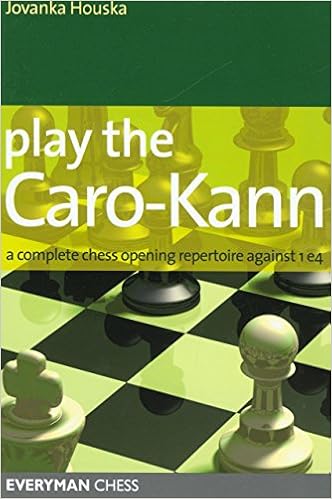
This type of active management of your openings is easily implemented using a simple database structure, which can be updated whenever you run across related material.  A recent personal example of doing this on a systematic level was comparing the recommendations in Play the Caro-Kann (made easier by its e-book format) with my repertoire database and evaluating the author's recommendations.  By no means did I accept all of her ideas, but studying the differences and determining why I preferred one line over another (or perhaps an entire variation) was valuable in itself.  This process is also quite useful when going over individual master-level annotated games that you come across, as in the Gormally example below.

Computer tools can be quite valuable for your preparation, but also misunderstood or misused.

Database programs easily display for you the most popular and highest-scoring lines, but their statistics can be misleading in various ways.  On the positive side, databases can identify shifts in popularity of particular lines and you can relatively easily pick out the important games that cause them.  On the other hand, sometimes there is a quick shift away from using a particular line that means the "old" (and maybe busted) version still has a relatively high percentage result, one of the reasons why you have to evaluate lines for yourself.
  • Popularity may also depend on the predicted result of the line - for example, many people may avoid a frequent drawing line as White, but perhaps you in fact want to have that as a solid weapon against higher-rated players.  Other lines may be unbalancing or relatively risky, but again that may be exactly what you need, as long as you understand the trade-offs in the positions you reach.
  • It matters which databases you use and why.  Correspondence games can be far more accurate than OTB collections, for example, so are very valuable to theory.  For practical use in OTB or online tournaments, though, it can be a bad decision to pick the theoretically "best" line if it runs 20+ moves of memorization, with multiple branching variations, and any deviation from it will likely benefit your opponent.
Engine recommendations also cut both ways.  They can be helpful, mainly for checking tactics and ideas to see what responses are likely and/or best.  They can also be potentially harmful to your game away from the computer.  Anyone who has worked extensively with engines knows that they may come up with certain moves in the opening that may look all right in the short term, but go against the main (human) ideas for the opening and so will cause problems 10-15 moves later.  One example I ran across early in my studies was in the main line of the Caro-Kann Exchange Variation, where most engines (even up until recently) evaluated 7...Na5 as best; you can even still see this on the ChessBase LiveBook with Fritz evaluations showing this as recently as 2016.  However, as Fischer-Petrosian (Belgrade 1970) and others have shown, it really does not work very well in practice.
  • Sometimes engine preparation can also give you a false sense of security, as illustrated by this entertaining example from GM Danny Gormally on a failed experiment in the Slav's Geller Gambit (as White).  On a practical level, I found his annotations useful and adjusted my own related Slav repertoire line as a result - but only after checking other database lines and engine possibilities and looking for myself at the positions.
  • Some computer products will give you a hard-coded numeric engine evaluation for literally every opening move, or you can replicate that by just running an engine.  I don't believe that these are very helpful in general and to evaluate lines you will have to follow them to the end and understand the why rather than letting something like a computer's "+0.25" fully define your view of them.
On a broader level, I think it's also important to understand and acknowledge the amount of work that will be needed in order to understand your chosen opening's positions and typical middlegame plans, then execute them in practice.  Some level of memorization is needed, if not of entire variations then things like key ideas, squares and principles for a particular opening.  Examples include the central important of the d5 square in the English Opening, the theme of the f5-f4 pawn advance in the Dutch, and the critical importance of the light-square bishop for Black in the King's Indian.  This type of opening lore I think is among the most valuable information for improving players and is why finding insightful explanatory material or having a coach who understands and can impart these principles is more important than following the latest professional theory, which often times is only expressed in long variations.

In the end, perhaps it's best to recall Kortchnoi's advice (mentioned in Annotated Game #175) to just go ahead and start playing a new opening, as - if you analyze your own games - that is how you will learn best what works and what doesn't in the opening.

28 May 2017

Annotated Game #175: Epic Stonewall exhaustion

This final round tournament game followed Annotated Game #174 and was the first time that I had essayed playing the Stonewall Dutch, outside of a simul game with GM Sam Shankland.  It taught me a lot about the opening, above all the need for patience (which I did not have enough of) when constructing a kingside attack.  There are many ups and downs in the course of the game - the critical phase starts at move 28 and goes all the way to the end of the game - and we were one of the last ones to finish in the round.  The toll of fighting a complicated battle for 30 moves straight along with the psychological downward trend in the end did me in, as I was exhausted from what felt like an epic fight, with my opponent on the ropes but eventually coming back.  However, there will be other opportunities.  It's also another data point telling me that energy management is something critical to watch (and improve) for my overall performance.

On that note, it's worth recalling something GM Viktor Kortchnoi said when asked about when someone should start playing a new opening they are in the process of learning.  Basically he asserted that you should just go ahead and start playing it in serious games, why not?  Losses will be inevitable, but there's really no other way to get better at it.  I like this outlook, which shouldn't be taken too literally by Class players - some preparation and study is essential, beyond just knowing the first few moves of a chosen opening - but it helps avoid the perfectionist trap of always thinking that your preparation is never "good enough" to play.  At some point, you just need to fire away.

[Event "?"] [Site "?"] [Date "????.??.??"] [Round "?"] [White "Class C"] [Black "ChessAdmin"] [Result "1-0"] [ECO "A85"] [Annotator "ChessAdmin/Komodo 10"] [PlyCount "119"] [EventDate "2016.10.10"] [EventType "schev"] [EventRounds "5"] {[%mdl 8192] A85: Dutch Defence: 2 c4 Nf6 3 Nc3} 1. d4 d5 2. c4 c6 3. Nf3 e6 ( 3... Nf6 {is the Slav Defense.}) 4. e3 f5 {with this move-order we have what is called a "Slav Stonewall".} 5. Nc3 Nf6 6. Bd3 Bd6 {the Modern Stonewall, instead of ...Be7.} 7. O-O Nbd7 {...O-O immediately is much more common here. No reason to wait.} 8. b3 {a standard plan for activating the dark-square bishop.} O-O 9. a4 {done to allow the bishop to get to a3 and exchange off its counterpart on d6.} Ne4 {a standard and often necessary move for Black in the Stonewall. In this position it is forcing, as the Nc3 is unprotected.} 10. Ne2 Qe7 {keeping my options open and also deterring Ba3.} 11. Ne1 {I welcomed this, as I felt it was a waste of time for White. The intent is obvious, to push f3, but moving the knight back to the first rank does not seem worth it.} g5 { I was in an aggressive mood from the start of the game and this move shows it. Not a very sophisticated approach.} (11... a5 $5 {would be good prophylaxis against White's queenside play.} 12. f3 Ng5 13. Qc2 $11) 12. f3 $14 Nef6 13. Nc2 g4 {a logical follow-up, as Komodo agrees.} (13... Kh8 {however might have been best to play immediately, as the king needs to vacate the g-file for a rook and I only do this much later in the game.}) 14. Ba3 c5 $6 {not a good decision, although my opponent does not take advantage of it.} (14... Bxa3 { is what the engine considers best. During the game, I wanted to preserve the bishop for use in the kingside attack.} 15. Nxa3 Kh8 $14) 15. dxc5 (15. cxd5 $5 {dissolves the center to White's advantage.} Nxd5 16. e4 gxf3 17. exd5 fxe2 18. Qxe2 $16) 15... Nxc5 16. b4 $2 {now my opponent is too aggressive.} Nxd3 $15 17. Qxd3 b6 $6 {it seems that I am not really looking hard at the position and its requirements. Developing the Bc8 is a nice idea, but there are other things that are more urgent, given the pawn tensions at f3 and c4 and a potential weakness at h2.} (17... gxf3 {would be the direct approach.} 18. Rxf3 dxc4 19. Qxc4 b5 20. Qxb5 Qc7 $15) (17... Qc7 {gives White no good options.} 18. cxd5 Bxh2+ 19. Kh1 Be5 $15) 18. cxd5 {this would have been strong earlier (move 15), but now I'm OK.} Nxd5 (18... gxf3 $5 {is better, as once the Nf6 moves away it no longer can recapture on g4 and get a good outpost.} 19. gxf3 ( 19. Rxf3 Bb7 $15) 19... Nxd5 $15) 19. b5 {my opponent now looks to simplify.} ( 19. fxg4 {would break up Black's kingside to good effect.} Qc7 20. g3 fxg4 21. Ncd4 $14) 19... Bxa3 $11 20. Qxa3 Bb7 21. Qxe7 Nxe7 $11 {we now have a very equal-looking middle/endgame position.} 22. f4 Rac8 23. Ncd4 {threatening e6.} Kf7 24. Rac1 $6 {this "obvious move" gives me the initiative as my Ne7 now springs to life.} (24. Kf2 $11) 24... Nd5 $15 {returning the favor by threatening e3.} 25. Kf2 Nb4 {threatening the fork on d3.} 26. Rb1 (26. Rfd1 Rxc1 27. Nxc1 Be4 $15) 26... Nd3+ {this is still a strong move.} 27. Kg3 $17 { White's king safety is now something of a problem, which along with my nicely centralized Nd3 gives me an advantage.} (27. Kg1 h5 $17) 27... h5 {here I correctly find the logical follow-up, which raises mate threats.} 28. Rfd1 $2 { this should lose, but the winning continuation is not obvious.} (28. h4 gxh3 29. Kxh3 Rg8 $17) 28... Be4 {a good follow-up move, but not nearly as good as the best move.} (28... h4+ {secures the point, comments the engine via the Fritz interface.} 29. Kxh4 Nf2 $1 {now the White king has no way back.} 30. Kg3 $2 (30. Nxe6 Rh8+ 31. Kg5 Kxe6 $19) (30. Nxf5 Rh8+ 31. Kg3 Ne4+ 32. Kxg4 Rcg8+ 33. Kf3 Nd2+ 34. Kf2 Rxg2+ $19) 30... Ne4+ 31. Kh4 Rh8#) 29. Nc6 $17 {eyeing the jump to e5 and threatening a7, something I gave too much weight to.} Rh8 $2 {now I'm not thinking aggressively enough.} (29... Kf6 {removes the check on e5.} 30. Nc3 h4+ 31. Kxh4 Nc5 $17) 30. Kh4 {this is enough to restore equality. } (30. Rxd3 $1 {is a simple forking tactic that gets two pieces for a rook.} Bxd3 31. Ne5+ Kf6 32. Nxd3 $16) 30... Nc5 31. Rb4 {this solves the dual threat to the Rb1 and a4, but not in the best way.} (31. Ne5+ $5 Kf6 32. Rbc1 $11 { and now Black cannot go pawn snatching:} Bxg2 (32... Nxa4 $4 33. Rd7 $1 { with mate coming.}) 33. Rxc5 Rxc5 34. Rd7 {and now} Rxe5 {is forced.} 35. fxe5+ Kxe5 36. Nf4 $14 {snagging the bishop, as a fork on g6 is threatened.}) 31... Bxg2 $15 (31... Bxc6 {was the other option.} 32. bxc6 Rxc6 $15 {this had the advantage of getting rid of preventing the knight from reaching e5.}) 32. Ne5+ {I was quite aware of the fact that I had potential mating threats, but now so does White, given the location of his knight and potential rook action on the 7th rank.} Kf6 33. Ng3 {naturally the h5 pawn is poisoned and can't be taken, due to the subsequent pin against the king.} Bd5 34. Rbd4 $6 (34. Rc1 $5) 34... Nb3 {the best move, but at this point I was tired and had relatively little time on the clock, so I didn't have a coherent follow-up plan.} 35. R4d3 $2 { looks obvious, but should lose.} (35. Rxd5 {is necessary and only leaves White slightly worse.} exd5 36. Rxd5 $15) 35... Rc2 $19 {again another best move and obvious follow-up, but without clear vision of a winning continuation. However, the next series of moves are simple enough.} 36. Nf1 Rhc8 37. Nd7+ Ke7 38. Ne5 Nc5 {good but perhaps not best. I felt I should at least keep making threats, feeling somewhat frustrated that I could not find a breakthrough.} 39. Rd4 Kf6 {played to take away the g5 square from White's king.} 40. h3 {now I felt I should be able to break through.} gxh3 41. Kxh3 Bg2+ {unfortunately here I could not find a winning idea, under pressure.} (41... Ne4 $5 {would bring another necessary piece into the attack, since d7 does not in fact need to be guarded.} 42. Nd7+ (42. Rxe4 fxe4 43. Ng3 Rc1 $19) 42... Ke7 43. Ne5 Rg8 44. Rxe4 Rg1 $19 {and mate threats mean White loses material.}) 42. Kh4 Bd5 43. Kh3 Rg8 (43... Ne4 {again is the key.} 44. Rxe4 fxe4 45. Ng3 Rc1 $19) 44. Ng3 h4 ( 44... Rg2 {Black missed this excellent chance, comments the engine.} 45. Nxh5+ Ke7 46. Nc6+ Kd6 $19) (44... Rh8 {is also good, preparing to push the h-pawn.}) 45. Nh5+ $17 Ke7 46. Nc6+ Kf8 {now we're back to equality...} (46... Bxc6 47. bxc6 Rgg2 $17) 47. Nf6 $2 {except that this (again) should lose for my opponent.} (47. Rxd5 {leads to a perpetual.} exd5 48. Rxd5 $11 {for example} Rg1 49. Rxf5+ Ke8 50. Nf6+ Kf8 51. Nh5+ Ke8 {etc.}) 47... Rgg2 48. Rh1 Ne4 $6 { unfortunately this was a good idea several moves ago, not now.} (48... Rg3+ { and Black wins} 49. Kxh4 {forced} Rg6 {with a double attack on the Nf6 and the h6 square (threatening the Rh1 via a skewer check).} 50. Rxd5 exd5 $19) (48... Rg6 $6 {immediately doesn't work, as White simply replies Nxd5.}) 49. Nxe4 $15 Bxe4 50. Rd8+ Kg7 51. Rd7+ $2 {again my opponent offers up an opportunity.} ( 51. Ne5 $11) 51... Kh6 $19 52. Ne5 Rg3+ {a great idea...on move 48. Here it blows the discovered attack by the Be4 on the Ra1, since the Rg3 will be hanging.} (52... Rgf2 {moving to e2 works fine as well.} 53. Kxh4 {forced} Bxh1 54. Nf7+ Kg7 55. Ne5+ Kf8 $19) 53. Kxh4 $11 {by this point I'm totally exhausted and out of ideas.} Rg7 {simplification is actually a good route to go and should result in a draw.} 54. Rh3 Rxd7 55. Nxd7 Rg2 {keeping hopes of a mate threat alive.} 56. Ne5 {The knight dominates, comments the engine (correctly).} Bc2 57. Rh1 Bxa4 58. Ra1 Bxb5 59. Rxa7 Be8 $2 {this really made no sense, but my brain was too tired from all the calculating and I missed the simple follow-up. The original idea was to dominate the Ne5.} (59... Rg7 { was simplest.}) 60. Re7 {at this point I just gave up, seeing that I would lose the two pawns and was exhausted. The game is far from over, though.} (60. Re7 Ba4 61. Rxe6+ Kg7 62. Rxb6 $14) 1-0

05 May 2017

E-book completed: Play the Caro-Kann


I've had the e-book version of Play the Caro-Kann (2007, Everyman Chess) by IM Jovanka Houska for a while now, but just recently took the time to go through it in a systematic way, after a previous false start.  There's a lot of material and it's more advanced than Starting Out: The Caro-Kann, although Houska's latest (2015) Opening Repertoire: The Caro-Kann is about double its predecessor's size.  (I have that as well and plan to follow up this year by looking at it seriously, which should provide some interesting comparisons.)

This is a valuable opening book in general, based on selected major repertoire lines for the Caro-Kann.  It does some things that many other opening books (whether a repertoire or "comprehensive" opening manual) do not.  In this case, Houska does a particularly fine job of highlighting both strategic and tactical issues associated with deviations from the central line, something clearly beneficial to improving players.  One of my general complaints as a Class player is that many opening books only give the "best play" and most contemporary lines.  Below master grade (but really even then), it's unlikely that your opponent will go straight down the "best" path that the book is so enthusiastic about.  (I put "best" in quotes because the "best" lines from 5, 10 or 20 years ago are unlikely to be the ones given today.  Sometimes entire major variations, like the Berlin Defense, are largely ignored but then resurrected and become "best", so it's best to think for yourself when building your own repertoire.)

Knowing on a deeper level the likely opening deviations and how to punish them (or at least get a better game) is key to getting a practical advantage out of your selected openings.  This is closely allied to the importance of understanding your openings' concepts, not just the latest variations; in many books play may be taken simply for granted until far into the game and the GM writing the book may not bother to even mention normal-looking alternatives.

Below are the chapter headings for the book with some commentary on content.
  • Chapter 1 - Main Line: Introduction and 11. Bf4.  The author chooses to start off with the 3. Nc3 main line, which is probably the most deeply analyzed historically, and selects the Classical (aka Capablanca) variation to meet it, 4...Bf5 (which I play).  Houska does a good job of discussing some of the introductory concepts about the variation while fast-forwarding ahead to move 11, which in this case is legitimate; I actually have played a number of games in which White can rattle off things automatically to this point (and beyond).  This particular chapter may not be 100% relevant to your repertoire if as a Caro-Kann player you don't play an early ...e6 instead of developing first with ...Nf6, but many of the lines transpose - it's hard to avoid playing ...Nf6 - and the various ideas are good to see in action regardless.  In particular, the ideas of hitting a white pawn on c4 with ...b5 and how to handle White's attacking idea of g2-g4 are well treated.
  • Chapter 2 - Main Line: 11 Bd2.  This is really the meat of the analysis for my repertoire and the foundation of the Caro-Kann main line, so all the ideas are relevant.  Knowing how to handle thematic White attacks like the sacrifices on h6, g6, f5 and e6 are very important, as is setting up Black's counterplay on the queenside and along the c-file in particular.  Caro-Kann players will get a sense of the cut-and-thrust of these positions and also have their morale boosted by seeing how dangerous-looking White attacks can be foiled.  In this chapter Houska also treats the early deviation 8. Bd3, in which White basically plays the same way but foregoes h4-h5, and suggests that Black go for queenside castling.
  • Chapter 3 - Main Line: 6. Bc4 and Early Deviations.  Here we find a White transposition to the Blackmar-Diemer Gambit (via 4. f3) and Houska advocates taking the pawn, which is principled but can be dangerous if you don't really know the lines. Her preference of following up with 5...Bf5 and subsequent play looks pretty straightforward for Black.  Separately, the main line with 5. Nc5 (used by Fischer a few times) is treated with 5...b6 as the standard response.  The various 6th move alternatives, especially 6. Bc4 and 6. N1e2, need to be studied carefully by Black players, since the ideas are different from the regular main line.  6. f4 is also a rather violent line and should be looked at, since it has good surprise value for White and Black needs to know recommended piece development (Bf8-d6, Ng8-e7).
  • Chapters 4-5 treat the Panov-Botvinnik Attack, using the theoretically recommended 5...Nc6 line, which requires Black (especially) to really know the sequences, since the variations are sharper and White has the initiative and some lasting pressure; however, Black is fine (or sometimes better) in the end, due to better structural and positional factors.  Instead I play the 5...e6 line, which is more solid and typically transposes into a position classified as a Semi-Tarrasch defense (from queen's pawn openings).
  • Chapter 6 - Exchange Variation.  This is especially popular with Bobby Fischer fans and relatively straightforward to play.  Houska uses 5...Qc7 for her repertoire, which is a strong move (but not the main line 5...Nf6) that pre-empts the usual Bf4 development for White. (For an entertaining post on the variation by a fellow improvement blogger, see "The Grinch during off season") 
  • Chapters 7-8 go over the Advance Variation, which at top levels has long replaced the "main line" (3. Nc3) as the most popular approach for White.  Interestingly, this hasn't really happened at the Class level (at least in my experience), which means that players of both sides may be put off to some extent by the large amount of theory after 3. e5 Bf5, which is the most logical choice for Black, who places the light-square bishop outside of the pawn chain before playing ...e6.  Houska instead advocates the sideline 3...c5 and does a good job of covering it in depth, which is rare in Caro-Kann literature.  It is the only real gambit variation in the Caro-Kann but it is still a quite solid approach in most lines, as White usually either has to give back the pawn or is left with no real prospects for making progress.  Black (as Houska advises) should concentrate on the positional compensation rather than desperately trying to recover the pawn, so it is a genuine gambit line.  It's worth noting that Houska after the main theoretical continuation 4. dxc5 only presents 4...e6 for Black, which is the second most popular choice (after 4...Nc6).  Both lines score about the same in the database (43% for Black).  I think it's mostly a matter of taste, as the position naturally becomes more French-like after the early ...e6. 
  • Chapter 9 - Fantasy Variation.  This line (with 3. f3!?) is a favorite of White players impatient with normal Caro-Kann lines who just want to attack on the kingside (similar in some respects to the approach of the Blackmar-Diemer Gambit per above).  The Kenilworthian blog summarized interest in the variation back in 2010.  If Black players just make mindless exchanges that leave the center wide open, then White has a nasty quick-developing attack.  That said, the theoretically most critical line has Black play 3...dxe4 followed by 4...e5 (and then the e5 pawn becomes the linchpin of the position).  Houska, who tried the line herself briefly, has an excellent summary analytic overview and emphasizes White's weakness on the dark squares (including f2), arguing that should be the basis of Black's strategy.  She notes that if Black players want to just have a solid game rather than challenging White, then 3...e6 and 3...g6 are good alternatives.
  • Chapter 10 - Panov's Little Brother: 2. c4.  It's good that Houska devotes an entire chapter to this line, which can be reached from multiple transpositional possibilities and can itself transpose into a full-fledged Panov-Botvinnik Attack.  Black can't simply ignore the unusual move and should be prepared for it.  Houska treats the main line approach, which after the pawn exchanges on d5 is to play 4...Nf6 rather than immediately recapturing with 4...Qxd5, which is reminiscent of the Center Counter defense.
  • Chapter 11 - Two Knights Variation.  This has always been at least somewhat popular at the Class level, I think largely because it's an obvious piece development.  Also probably because White gets some cheap points after unwary Black players try to treat it like the Classical Caro-Kann and exchange on e4 followed by 4...Bf5?!, which gets punished every time by White (per the above link).  The standard antidote (covered by Houska) is 3...Bg4, which is good for Black if the positional ideas behind it are understood (maintain the light-square bind with the pawns, don't open the position further).  It's again worth noting the quality job Houska does of explaining the key ideas and plans, rather than giving a variation or two with a one-sentence comment.
  • Chapter 12 - King's Indian Attack.  (Yet another Fischer sideline in the Caro-Kann.)  A more common setup against the French or Sicilian (as illustrated in the above link), it can also be used against the Caro-Kann.  Black has nothing to fear, in this case having a couple of advantages (already having the d5/c6 pawn chain and the move ...e5 available early) and so equalizing rather quickly, has been my experience.  Both the KIA and the Caro-Kann are solid openings, so there are few fireworks and the middlegame tends to be one of slow maneuvering rather than breakthroughs.  If you play the KIA as White in other openings and don't want to learn something new against the Caro-Kann, it's certainly a practical option.  Houska devotes a full chapter to it and a number of variations that are unlikely to appear on the board, mainly White deviations from the 5. g3 setup, so it may be more valuable in practical terms for White players looking for alternatives.
  • Chapter 13 - Unusual Lines and the Plain Bizarre.  The most important/relevant line here I think is 2. f4, which Black meets by playing in the style of the Advance Variation (with 3...Bf5) but I've also seen in practice the line 2. Nf3 d5 3. exd5 cxd5 4. Ne5, which has been used by some top Grandmasters for surprise value.

30 April 2017

Annotated Game #174: Choke

For those not familiar with the word "choke", it refers in English slang to when an individual sportsperson (or sometimes an entire team) is presented with a clear winning opportunity during an important moment, but instead they screw it up and lose.  This next tournament game is a great example of this phenomenon.  After three wins in a row I was paired against the leader of the section and had a chance to move into first place with one round left to play.  Instead, after doing well in an aggressive English Opening (yes, the English can be aggressive), I was one move away from victory, but instead had a major thinking process failure on move 24 (trapping my opponent's queen...except for the one move that beat me).  It had been a rather exciting and somewhat exhausting game up until that point, so even though it was relatively early on move-wise, I had expended a good amount of clock time and a lot of mental energy on calculating variations since the unexpected 17th move from my opponent.  Basically I lost patience and decided to skip the process...with unfortunate consequences.  Lesson learned.

[Event "?"] [Site "?"] [Date "????.??.??"] [Round "?"] [White "ChessAdmin"] [Black "Class C"] [Result "0-1"] [ECO "A13"] [Annotator "ChessAdmin/Komodo 8"] [PlyCount "56"] [EventDate "2016.10.10"] [EventType "schev"] [EventRounds "5"] {[%mdl 8192] A13: English Opening: 1...e6} 1. c4 e6 2. Nf3 d5 3. e3 Nf6 4. b3 Be7 {now in a standard QGD type setup for Black.} 5. Bb2 Nbd7 6. Be2 b6 7. O-O Bb7 8. Nc3 (8. d3 {is an option, with the idea of Nbd2.}) (8. cxd5 $5 { immediately is more common than the text move.}) 8... O-O 9. cxd5 {this seemed the logical follow-up. I've previously had bad experiences with Black building a strong pawn center and this takes care of that problem.} Nxd5 (9... exd5 10. Rc1 Re8 11. Qc2 Bf8 12. Rfd1 c6 13. d4 Bd6 14. Bd3 Qe7 15. Ne2 g6 16. Ng3 Ng4 17. Re1 f5 18. Bxf5 gxf5 19. Nxf5 Qf8 20. e4 Bf4 21. e5 Re6 22. Rcd1 Kh8 23. g3 Qg8 24. Kh1 {Gunina,V (2529)-Kriebel,T (2461) Novy Bor 2015 1/2-1/2 (157)}) 10. Rc1 (10. Nxd5 {is more common. The Nc3 isn't a great piece and it's better to exchange it, also opening up the long diagonal for the Bb2 (and the c-file for a rook).} Bxd5 11. Qc2 c5 12. Rad1 Rc8 13. Qb1 Qc7 14. d4 Qb7 15. Rc1 cxd4 16. Bxd4 Bf6 17. Qb2 Bxd4 18. Qxd4 Nf6 19. h3 h6 20. Qa4 a5 21. Qd4 Rc7 22. Qe5 Rfc8 23. Ba6 {1-0 (23) Alekseev,E (2679)-Rusanov,M (2440) St Petersburg 2014}) 10... Bf6 11. d4 {here I decided the benefits of the pawn advance outweighed shutting off the Bb2. First of all, Black's Bf6 is also shut out, and I also get a strong central pawn that influences e5 and c5. The a3-f8 diagonal also looks like a good one for my bishop.} Rc8 $146 {a slow move and one that allows the following sequence, giving me a measurable edge.} (11... Nxc3 12. Bxc3 c5 $11) 12. Nxd5 $14 Bxd5 (12... exd5 13. Ne5 Nxe5 14. dxe5 Be7 15. Bg4 Ra8 16. Qc2 c6 17. f4 $14) 13. Ba6 {this is the problem with the earlier rook move, Black loses a tempo and his queenside is looking awkward.} Rb8 14. Bd3 { I had been worried about a possible future ...b5, blocking the bishop in. Another square might have been better, though.} (14. Bb5) (14. Qe2 {is another option the engine likes, controlling the diagonal (and b5) while connecting the rooks and protecting the Bb2, which is otherwise loose.}) 14... c5 { the logical reaction by Black, taking advantage of the unprotected Bb2 to rule out capture on c5.} 15. Ne5 {a somewhat risky and aggressive decision that was not the best. I didn't mind the exchange on e5, and it is evaluated by the engine as equal.} (15. Qe2 cxd4 16. Nxd4 Rc8 $14) 15... Bxe5 $6 {a case where the standard rule of not exchanging bishops for knights applies.} (15... cxd4 $5 16. exd4 Nxe5 17. dxe5 Be7 $11) (15... Nxe5 16. dxe5 Be7 $11) 16. dxe5 $14 { White has the pair of bishops, but also the Nd7 has no useful squares at the moment.} Qg5 {this surprised me, but I was able to find an effective countermove.} 17. e4 {now I have the initiative.} Bc6 18. f4 {the queen's location becomes a problem for Black.} Qh4 19. Rc2 (19. Rc3 $5 {is probably a better version of the idea of transferring the rook to the kingside (after Bc2) and one that I considered for a while. In the end I rejected a plan of a piece attack on the kingside for one based on a pawn advance.} Qe7) 19... Rbd8 20. g3 (20. Qe2 $16 {getting off the d-file and overprotecting e4 was an excellent idea.}) 20... Qh3 $6 {this over-optimistic move justified my play to this point.} (20... Qe7) 21. Rd2 $16 {screening the Qd1 and protecting the Bd3 again.} f6 $2 {causes even greater problems, in part because the Qh3 now has no safe retreat. It also weakens e6, which I take advantage of (but not well enough).} (21... Nb8 $16 {looks sad, but otherwise Black has serious problems.} ) 22. f5 {I thought for a while here and felt good about the move, which presses the attack, but is rather complicated given the various captures on e5, f5 and e6.} (22. Be2 {is found by the engine the threat being to play Bg4 with a fork on e6.} f5 (22... h5 23. exf6 Bxe4 24. Rf2 gxf6 25. Bxh5 $18) 23. Bc4 Rfe8 24. Rd6 Bxe4 25. Rf2 Qh6 26. Rfd2 $18) 22... Kh8 $2 (22... Qh6 23. Bb1 Qe3+ 24. Rff2 $18) 23. Rf4 $1 {this should be sufficient to win. The threat of course is Rh4, trapping the queen.} Qh6 24. Rh4 $4 {here I moved too quickly and had a major thinking process foul. I had assumed that the queen was trapped, but of course it now has e3 to go to, with devastating effect. This was a case of the actual piece placement (Rf4) interfering with my mental visualization of the future board (Rh4, Qh6), where the diagonal is no longer blocked. Naturally if I had followed my thinking process, I could have corrected for this.} (24. fxe6 $1 {and wins.} fxe5 25. Rxf8+ Nxf8 26. e7 $18 { I had in fact looked at this variation, but was tired and having trouble visualizing. And then it occurred to me (mistakenly) that I could just play Rh4.}) 24... Qe3+ $19 {after this it is game over, although I fight on for a few moves in the vain hope for a swindle.} 25. Kf1 Nxe5 26. Qh5 Qf3+ 27. Ke1 Qxh5 28. Rxh5 Nxd3+ 0-1