[Event "?"]
[Site "?"]
[Date "????.??.??"]
[Round "?"]
[White "Class D"]
[Black "ChessAdmin"]
[Result "1/2-1/2"]
[ECO "B18"]
[Annotator "ChessAdmin/Komodo 10"]
[PlyCount "38"]
{B18: Classical Caro-Kann: 4...Bf5 sidelines} 1. e4 c6 2. d4 d5 3. Nc3 dxe4 4.
Nxe4 Bf5 5. Ng3 Bg6 6. Nf3 Nf6 7. Bc4 e6 8. O-O Nbd7 {a solid move, but it
allows White to establish the Bf4.} (8... Bd6) 9. Bf4 Nb6 {not a good decision.
I waste time in the opening by driving my opponent's bishop to a better square,
while moving the same piece twice.} (9... Be7 10. Re1 O-O 11. Nh4 Qb6 12. Nxg6
hxg6 13. Bb3 Rfd8 14. c3 c5 15. Ne2 e5 16. dxe5 Nxe5 17. Qc2 Nd3 18. Red1 c4
19. Be3 cxb3 20. axb3 Qb5 21. Nd4 Rxd4 22. Bxd4 Nf4 23. Rxa7 Rxa7 24. Bxa7 {
Djacic,N-Maric,A (2407) Cetinje 2009 0-1 (34)}) 10. Bd3 {White has an active
position, notes Komodo via the Fritz interface.} Nbd5 $146 {hitting the bishop
and centralizing the knight, but I am still under-developed. Again, White's
bishop is driven to a better square as well.} (10... Bd6 11. Be5 O-O $11) 11.
Be5 Bd6 {a little late with the idea and not really helpful for me.
Unfortunately, taking with the bishop on e5 would simply give White a strong
e5 pawn and kick the Nf6, gaining a tempo. With the dark-square bishop gone, I
also would have more trouble covering the dark squares on defense. The bishop
is actually something of a liability on d6 for me, as the Qd8 is tied to its
defense.} (11... b5 {is the engine's recommendation of a prophylactic move, to
help preserve the Nd5 on its square. Whenever Black puts a knight on d5 in
this variation, if White can advance a pawn to c4 to kick it off the square,
it's not very well placed.} 12. h4 $14) (11... Nd7 $5 {might be a better
version of the idea to exchange the Be5.}) 12. Re1 (12. c4 {would give White
the initiative.} Ne7 13. Bxg6 hxg6 14. Qb3 Rb8 $14) 12... O-O {removing the
king from the e-file, very important for tactical reasons as well as
developmental.} 13. Qd2 {my opponent continues to play decent but somewhat
slow moves.} b5 {here I recognize the importance of defending the Nd5 outpost
and implement the prophylactic idea (a bit late).} (13... Be7 {is also an
option, acknowledging that the trade on e5 will not happen with the bishop and
allowing ...Nd7.}) 14. a4 (14. c3 Be7 $11) 14... a6 (14... b4 {is a superior
continuation, gaining space.} 15. c4 bxc3 16. bxc3 Be7 $11 {and now if} 17. c4
Bb4 $15 (17... Nb4 {also works.})) 15. h3 {presumably done to prevent ...Ng4.}
(15. axb5 {is probably the most challenging way to continue, but after a
series of piece exchanges White will not have enough material to push an
attack.} cxb5 {forced.} (15... axb5 $2 16. Rxa8 Qxa8 17. Bxd6 $18) 16. Bxd6
Qxd6 17. Ne5 Bxd3 18. Qxd3 $11) 15... Re8 (15... Qc7 $5 16. Bxd6 Qxd6 17. c3)
16. Ne4 {this allows for simplification into a drawish position.} Nxe4 17. Bxe4
Bxe4 18. Rxe4 Nf6 {this seemed the obvious move at the time, although it would
allow White to try to create something on the h-file with Rh4.} (18... f6 {
is forcing with the Bd6 and also takes away the g5 square from White's knight.}
19. Bxd6 Qxd6 20. Rae1 {White can try to pressure the e-pawn but without
prospects for success.} Re7 $11 {is the safe response, leaving e8 open for the
other rook.}) 19. Ree1 (19. Rh4 Qe7 $11) 19... h6 {I correctly evaluated the
position here as having no winning prospect for myself, with any chances on my
opponent's side, so accepted a draw.} (19... Be7) 1/2-1/2
26 February 2017
Annotated Game #166: Even short draws have lessons
Having finished off the 2016 master-level commentary games, I'll turn back now to looking at my tournament games. At first glance this 19-move draw seems pretty worthless, but in fact analyzing it really gave me some insights into some key mechanics of the Classical Caro-Kann setup, especially how Black should coordinate the pieces - note the uselessness and even the liability that the Bd6 proved to be here - and think prophylactically (11...b5!?). The opening itself veers out of book early on (moves 6-7), something I did not handle very well. My opponent was rated significantly below me, but played well and I had the worst of a position with no prospects, so the draw was probably the best outcome.


22 February 2017
Commentary: 2016 London Classic Round 4 (Topalov - Nakamura)
(The original ChessBase article including this game can be found at https://en.chessbase.com/post/london-chess-classic-rd-4)
This next commentary game between two Super-GMs (Veselin Topolov and Hikaru Nakamura, from the 2016 London Classic in December) is a great contemporary example of the 3...c5 variation in the Advance Caro-Kann. It is the only real gambit continuation in the Caro-Kann defense and is a legitimate alternative to 3...Bf5, which however is much more popular (and theoretical). Here both sides are spoiling for a fight, as shown especially by Black's 9th move and White's 11th move choices. Topalov gets the worst of it, however, overextending his queenside which is undermined with the key 11...a5, which has a number of unpleasant consequences for White. Topalov throws caution to the winds with a queen sac on move 18, going "all in" on his aggressive idea, but Nakamura then capably quashes White's counterplay and essentially cruises to victory. A model game to study for Caro-Kann players and in general, as it contains some important thematic ideas in the opening, along with a slew of middlegame tactics and a virtuoso demonstration of the power of the queen when she is mobile and her opposition is uncoordinated.
This next commentary game between two Super-GMs (Veselin Topolov and Hikaru Nakamura, from the 2016 London Classic in December) is a great contemporary example of the 3...c5 variation in the Advance Caro-Kann. It is the only real gambit continuation in the Caro-Kann defense and is a legitimate alternative to 3...Bf5, which however is much more popular (and theoretical). Here both sides are spoiling for a fight, as shown especially by Black's 9th move and White's 11th move choices. Topalov gets the worst of it, however, overextending his queenside which is undermined with the key 11...a5, which has a number of unpleasant consequences for White. Topalov throws caution to the winds with a queen sac on move 18, going "all in" on his aggressive idea, but Nakamura then capably quashes White's counterplay and essentially cruises to victory. A model game to study for Caro-Kann players and in general, as it contains some important thematic ideas in the opening, along with a slew of middlegame tactics and a virtuoso demonstration of the power of the queen when she is mobile and her opposition is uncoordinated.
[Event "8th London Classic 2016"]
[Site "London ENG"]
[Date "2016.12.12"]
[Round "?"]
[White "Topalov, V."]
[Black "Nakamura, Hi"]
[Result "0-1"]
[ECO "B12"]
[WhiteElo "2760"]
[BlackElo "2779"]
[Annotator "ChessAdmin/Komodo 10"]
[PlyCount "106"]
[EventDate "2016.??.??"]
1. e4 c6 2. d4 d5 3. e5 c5 4. dxc5 Nc6 5. Nf3 Bg4 {the standard reaction after
Nf3 in this version of the Advance variation. The ability to pin the Nf3 is
one of the benefits of playing 3...c5 rather than ...Bf5.} 6. c3 {this deters .
..Qa5 and prepares the b-pawn advance.} (6. Bb5 {is the main move here.}) 6...
e6 7. b4 a6 {preventing ...Bb5, but slowing development.} (7... Nge7 $5) 8.
Nbd2 Nxe5 {this is an earlier and an easier recovery of the pawn than is
normal for Black in the variation. White in this line has chosen to emphasize
queenside play instead.} 9. Qa4+ Nd7 {now out of the database. This move
choice preserves the queens on the board and indicates that Nakamura wants a
middlegame fight.} (9... Qd7 {had been tried twice before in the database,
both times resulting in a loss. Most recently:} 10. Qxd7+ Nxd7 11. Bb2 Bxf3 12.
Nxf3 Be7 13. Be2 Bf6 14. O-O Ne7 15. Rab1 O-O 16. c4 a5 17. Bxf6 gxf6 18. a3
axb4 19. axb4 Ra2 20. Rfe1 Ne5 21. cxd5 Nxf3+ 22. Bxf3 Nxd5 23. Bxd5 exd5 24.
Re7 Rb8 25. g3 Rd2 26. Rd7 Rd4 27. Rd6 Rc8 28. Rxf6 Rc6 29. Rd6 Rd2 30. Kg2 Kf8
31. Kf3 Rd4 32. Rd8+ Kg7 33. Rb2 Rf6+ 34. Kg2 b6 35. cxb6 Rxb6 36. b5 Rd1 37.
Kf3 Kf6 38. Ke2 Rd4 39. Rb3 Ke7 40. Ra8 Re4+ 41. Kf3 Ree6 42. Ra7+ Kf6 43. Kg2
Kg6 44. Ra4 h6 45. Rd4 Red6 46. Kf3 Kf6 47. Ke3 Rd8 48. Rf4+ Ke5 49. Rxf7 d4+
50. Kd3 Rd5 51. Re7+ Kf5 52. Re4 Rdxb5 53. Rxb5+ Rxb5 54. Rxd4 {1-0 (54)
Nevednichy,V (2554)-Zelcic,R (2548) Tromsoe 2014}) 10. Ne5 Ngf6 {Nakamura is
not concerned about the knight for bishop trade on g4 and continues with
development.} 11. c4 $6 {while active-looking, the main problem with this move
is that it leaves White's queenside pawns overextended, which Nakamura takes
advantage of with his next move. Presumably Topalov was looking to exchange on
d5 at some point and get rid of his doubled pawns.} (11. Nxg4 {is a more
obvious follow-up, obtaining the two bishops, although it doesn't offer much
for White beyond equality. Topalov is obviously trying for more, which
requires the knight to stay on e5.} Nxg4 12. Be2 Qh4 $5 (12... Nge5 $11) 13.
Bxg4 Qxg4 $11) 11... a5 {now White cannot take on a5 or advance the b-pawn
without losing the c5 pawn.} 12. Nb3 (12. cxd5 axb4 13. Qb5 Bxc5 $15) 12...
axb4 {this capture is made even more annoying for White because the Queen is
tied to the pin of the Nd7, which otherwise could take the hanging Ne5, so
recapturing on b4 is not possible.} 13. Qb5 {the only move.} Be7 14. c6 {
this looks a bit scary at first, but Black emerges unscathed from the sequence
rather better.} (14. cxd5 {doesn't seem to work any better for White, as after}
O-O 15. Nxg4 (15. d6 Nxe5 $17) 15... Nxg4 {White either must accept the loss
of the c5-pawn or allow Black to go into a dangerous-looking sequence with} 16.
h3 Nxf2 (16... Nge5 {is the safe alternative}) 17. Kxf2 Bf6 18. Rb1 Rxa2+)
14... bxc6 $15 15. Nxc6 Qc7 {and the b-pawn is tactically protected. White
does not have sufficient compensation for the sacrificed pawn and has no good
choices at this point.} (15... Qb6 $6 {looks tempting, directly protecting the
b-pawn, but is worse for Black after} 16. Be3 Qxb5 17. cxb5 $14 {and now the
advanced b-pawn White has acquired is a strength rather than a liability.}) 16.
f3 (16. Nxb4 $2 Rb8 {winning material.}) 16... Bf5 {so the bishop ends up on
f5 after all, and is nicely placed there.} 17. Nxe7 Rb8 {a key intermediate
move, preserving the b-pawn.} 18. Nxf5 $2 {now Topalov goes "all in" with the
material sacrifice, which has some shock value but favors Black.} (18. Qa5 {
this more solid alternative must have looked unappetizing to Topalov after}
Qe5+ 19. Kf2 Kxe7 $15) 18... Rxb5 19. Nxg7+ Ke7 $17 {Black does not have to be
in a rush to trap the knight with ...Kf8.} 20. cxb5 Nc5 {this allows time for
White to seize the long diagonal.} (20... Qe5+ $1 21. Be2 Nc5 22. Rb1 Nd3+ 23.
Kf1 Nxc1 24. Rxc1 Nd7 $17) 21. Bb2 Nxb3 22. axb3 $11 Qf4 23. Be2 {although
White must be desperate to activate his pieces, this gives Black time to do
the same, getting his rook into play very effectively.} (23. Ra7+ $5 Nd7 24.
Nf5+ {now the bishop's presence on b2 is a saving grace for White.} exf5 25.
Rxd7+ Kxd7 26. Bxh8 $11) 23... Rc8 24. Rd1 Qg5 {this looks quite threatening
to both the Ng7 and g2 pawn, but moving the rook to c2 immediately appears
stronger. The Ng7 is dead anyway and the Rc2 creates new threats.} 25. b6 $6 (
25. O-O Qxg7 26. Bd4 {and Black may have a slight edge, but no immediate
threats.}) 25... Rc2 26. Bxf6+ Qxf6 27. Nh5 {a nice try at extracting the
knight, but now the Black queen and rook combine well in making new, decisive
threats.} (27. b7 Qc3+ 28. Kf1 Qc7 {and the b-pawn is indefensible.}) 27...
Qc3+ 28. Kf1 Qe3 $19 {now the power of the queen is demonstrated. Black will
pick up both of White's defenseless queenside pawns, while the rook on the
second rank helps paralyze White's pieces. Note how poorly they coordinate and
the fact that the Rh1 is completely out of play, with the Nh5 not much better.}
29. Re1 Qxb6 {an easy path to victory, as White is essentially helpless.} (
29... d4 $5 {is the engine's preference, ramming through the passed pawn and
picking up the Be2. For example} 30. b7 d3 31. Ng3 dxe2+ 32. Nxe2 Qb6 $19) 30.
Nf4 Qe3 31. g3 Qxb3 {Topalov now tries to put up a fight and activate his
pieces, but it's too late. Just seeing the passed d- and b-pawns makes it
rather obvious.} 32. Kg2 Kf8 33. Kh3 Qb2 34. Rb1 Qf6 35. Rhe1 (35. Rxb4 Qh6+
36. Kg2 e5 $19 {and White loses a piece.}) 35... e5 {again, Nakamura chooses a
straightforward winning path.} (35... Qf5+ {would allow Black to play a
tactical trick using the h7-b1 diagonal.} 36. Kg2 e5 37. Nxd5 Rxe2+ 38. Rxe2
Qxb1 $19) 36. Nxd5 Qe6+ 37. Kg2 Qxd5 38. Rxb4 Qd2 39. Rb8+ {getting out of the
queen fork} Kg7 40. Kf1 Qh6 41. Kg2 (41. Rb4 $5) 41... e4 {the correct break,
opening White's position further.} 42. Rb3 Qe6 {White's king remains the more
vulnerable one, due to Black's mobility and Q+R combination.} 43. Re3 exf3+ 44.
Kxf3 Qh3 45. Rd1 (45. Rh1 $2 Qf5+ 46. Kg2 Qd5+ 47. Kg1 Rc1+ 48. Bf1 Rxf1+ 49.
Kxf1 Qxh1+) 45... Qh5+ {a strong intermediate check that heightens the impact
of the capture on h2, with tempo.} 46. Kf2 (46. g4 $2 {is no help} Qh3+) 46...
Qxh2+ 47. Kf3 Rc6 {a strong redeployment of the rook. Black again has time to
spare, with a lack of any White counterplay.} 48. Rd4 Rg6 49. g4 Rf6+ 50. Ke4
Qh1+ 51. Kd3 Qb1+ {note how White's two rooks actually hinder rather than help
him, in the face of the queen's mobility.} 52. Kd2 Qb2+ 53. Kd3 Rc6 {and White
loses material.} 0-1
05 February 2017
Book completed - Play the Dutch
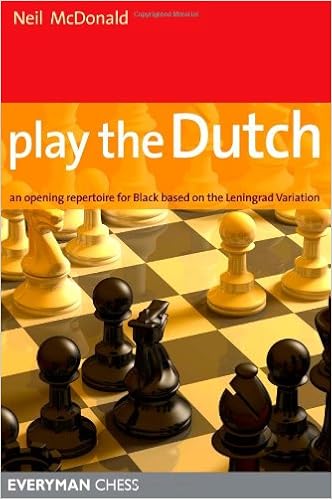
I recently completed Play the Dutch by GM Neil McDonald (Everyman Chess, 2010), which per the book's subtitle is "an opening repertoire for Black based on the Leningrad Variation". It is also a direct follow-up to his Starting Out: The Dutch Defence which provides an orientation to all of the main Dutch variations (Stonewall, Classical and Leningrad). The "Play the..." series of books are intended to be more focused and intermediate versions of the "Starting Out..." openings series from Everyman.
In this case, McDonald offers his preferred repertoire, although not too narrowly, for example discussing two of the three main options in the main line Leningrad (7...c6 and 7...Nc6) and offering some refinements on the Anti-Dutch sidelines in the earlier book. Here's the table of contents, for reference:
Gambit Lines and Early Oddities
White Plays 2 Nc3
White Plays 2 Bg5
White Avoids an early g2-g3 against a Leningrad Set-up
Sidelines in the Leningrad Variation
The Main Line Leningrad: 7 Nc3 c6
The Main Line Leningrad: 7 Nc3 Nc6
The Dutch versus 1 Nf3 and 1 c4
Some general observations:
- The book is very reader-friendly, both in terms of writing style and visual presentation. To do serious work with it you'll of course need a board and/or database program to review the material, but it can be followed along with only moderate effort on a first read-through.
- The Leningrad Dutch is a tactics-heavy and sometimes tricky opening, one in which the theory of individual lines (or even whole variations) can change relatively rapidly based on new games and ideas. This book should not be used for the latest theory, but that's not its intent: it's designed more to present key ideas, themes and specific reasoning behind the highlighted lines, at an intermediate rather than advanced level. It does this the best of all of the Leningrad Dutch books I have looked at.
- If you have a coach familiar with the Leningrad, then this book is probably redundant, but for those of us without coaches, it can be quite helpful in getting to the next level of understanding about the opening and its middlegame ideas, something which McDonald emphasizes in the complete annotated games that the book is built around. He makes the effort to highlight similar plans and themes across games (including things like the ...f4 thrust and the utility of ...Nf6-h5 in attacking situations), which will be very important to achieving practical success using the opening.
- The book should greatly assist the reader in delving further into Leningrad ideas and exploring lines, but does not offer a 100% concrete, fully tested repertoire. I don't think this is a bad thing, as long as you realize that the book is a good resource, rather than meant to be used as your gospel and only opening resource. (Probably a good attitude to have about any openings book.)
- The main line treatment with 7...Nc6 is welcome, but it's also limited to Black's response 8...Na5 (after 8. d5 is played). So the other main alternative 8...Ne5 is completely ignored (unlike in the Starting Out book), which means if you are a Black player, you really should take a look at it as well as 8...Na5, given some (known) difficulties there. GM Viktor Moskalenko's related observations and analysis in The Diamond Dutch are very useful in understanding the trade-offs between the two lines.
22 January 2017
Commentary: 2016 Tal Memorial Round 6 (Aronian - Giri)
Although I've previously mentioned that I tend not to choose games for commentary from the super-GM class, the last batch I selected from 2016 all feature top names who happened to play brilliantly (and understandably) in my general opening repertoire, so I felt I couldn't ignore them!
This next commentary game, from round 6 of the Tal Memorial tournament, features brilliant maneuvering from GM Levon Aronian in an English, which helps show the latent power of the central setup. There are some key thematic observations on positional topics, such as what happens with the light-squared bishop exchange on h3, but the focus of the game is on the queenside pressure and crush that Aronian builds up after his opponent (GM Anish Giri) allows him the initiative. In the resulting sequence, I think that most of the rest of us would decide on the option 21. Nxe5 (and not necessarily be wrong to do so), but Aronian's more complex 21. Na5 followed by an exchange sacrifice is a model of positional and tactical effectiveness. It is well worth breaking down the individual sequences of tactical ideas and how Aronian strings them all together with his final back-rank threats and winning knight maneuver.
This next commentary game, from round 6 of the Tal Memorial tournament, features brilliant maneuvering from GM Levon Aronian in an English, which helps show the latent power of the central setup. There are some key thematic observations on positional topics, such as what happens with the light-squared bishop exchange on h3, but the focus of the game is on the queenside pressure and crush that Aronian builds up after his opponent (GM Anish Giri) allows him the initiative. In the resulting sequence, I think that most of the rest of us would decide on the option 21. Nxe5 (and not necessarily be wrong to do so), but Aronian's more complex 21. Na5 followed by an exchange sacrifice is a model of positional and tactical effectiveness. It is well worth breaking down the individual sequences of tactical ideas and how Aronian strings them all together with his final back-rank threats and winning knight maneuver.
[Event "10th Tal Mem 2016"]
[Site "Moscow RUS"]
[Date "2016.10.02"]
[Round "?"]
[White "Aronian, Levon"]
[Black "Giri, Anish"]
[Result "1-0"]
[ECO "A20"]
[WhiteElo "2795"]
[BlackElo "2755"]
[Annotator "ChessAdmin/Komodo 10"]
[PlyCount "67"]
[EventDate "2016.??.??"]
1. c4 e5 2. g3 {this very early fianchetto is a popular way to play the English
} Nf6 3. Bg2 d5 {the most challenging, immediately looking to establish a
central presence.} 4. cxd5 Nxd5 5. Nf3 Nc6 {now it looks like a reversed
Sicilian, doesn't it? In fact that is how ECO classifies it.} 6. O-O Nb6 7. d3
{with Black controlling d4, White must opt for a more restrained game, looking
to control the center with pieces, which is the point of the original setup.}
Be7 8. Be3 O-O 9. Nbd2 {this move eyes both e4 and c4, but neglects d5. It
does leave the c-file half-open for White's rook, though.} (9. Nc3 {would be a
fine (and more natural) alternative development for the knight, focusing more
on the key d5 square.}) 9... Be6 (9... Nd5 $5 {would be the way to immediately
take advantage of the knight development; the engine considers the resulting
position completely equal after 10. Rc1 and the exchange on e3. The only other
game in the database continued} 10. Nc4 Nxe3 11. Nxe3 Re8 12. Rc1 Bf8 13. Rxc6
bxc6 14. Qc2 Rb8 15. b3 Bd7 16. Nd2 Rb6 17. Ne4 a5 18. Nc4 Ra6 19. Nb2 Be6 20.
Nc5 Bxc5 21. Qxc5 Bd5 22. Rc1 Bxg2 23. Kxg2 Qd5+ 24. Qxd5 cxd5 25. Rxc7 Raa8
26. Na4 Rec8 27. Re7 Re8 28. Rd7 Red8 29. Re7 f6 30. e3 Rac8 31. d4 exd4 32.
exd4 Re8 33. Ra7 Rc2 34. Nc5 Ree2 35. Ra8+ Kf7 36. Ra7+ Kg6 37. Nd3 Kh6 38. Kf3
Red2 39. Ke3 Re2+ 40. Kf3 Rxa2 41. Rd7 g5 42. Rxd5 Kg6 43. g4 Red2 44. Ke3 Re2+
45. Kf3 Red2 46. Ke3 h5 47. h3 h4 48. Rd6 Rd1 49. Ne5+ Kg7 50. Rd7+ Kg8 51.
Rd8+ Kg7 52. Rd7+ Kg8 53. Rd8+ Kg7 54. Rd7+ Kg8 55. Rd8+ Kg7 56. Rd7+ Kg8 57.
Rd8+ Kh7 58. Rd7+ Kg8 59. Rd8+ Kg7 60. Rd7+ Kg8 61. Rd8+ Kg7 {1/2-1/2 (61)
Artemiev,V (2663)-Matlakov,M (2691) Sochi 2016}) 10. Rc1 Qd7 {telegraphing
Black's intent to exchange the g2 bishop.} 11. a3 {sort of a waiting move, but
also done to take away the b4 square from Black (usually to prevent ...Nb4 as
a reaction to Qc2).} Bh3 12. Bxh3 {masters can play this move with ease in the
English, even though it looks anti-positional. If Black could follow it up by
bringing additional pieces into a kingside attack, then it would be bad, but
often the exchange on h3 simply means that Black's queen is offsides for a
while.} (12. b4 {is not a bad other option, but in this position White doesn't
have much more to gain beyond this move on the queenside, so taking the time
to first get Black's queen out of position is worth it.}) 12... Qxh3 13. b4 $14
Bd6 {this is done to protect e5 and subsequently maneuver the Nc6, but it
seems somewhat contrived, as if Black has nothing better to do. Bringing the
queen back on side with ...Qe6 or ...Qd7 would seem more productive.} 14. Qb3 {
the natural spot for the queen, which no longer faces opposition from a bishop
on the light squares and has a beautiful diagonal now; this is another reason
why Aronian was happy to exchange off the bishops.} Ne7 15. d4 {Aronian judges
the time is right to release some of the pent-up energy of his minor pieces
clustered in the center and challenge/eliminate Black's presence there.} exd4 {
essentially forced, as it would be more awkward for Black to try to defend
with something like ...Nc6.} 16. Bxd4 {now the bishop has an excellent
diagonal as well and cannot be easily opposed by its Black counterpart.} Nc6 {
Black moves to trade off the centralized bishop.} 17. Ne4 {White has to be
careful to maintain momentum here. Piece activity is more important than
avoiding the bishop for knight swap.} (17. Bb2 {for example would allow Black
to get some counter-pressure with} Rfe8) 17... Nxd4 18. Nxd4 {White's pair of
knights are doing well by being centralized, while Black's minor pieces are
comparatively restricted.} Qd7 $6 {Here Giri seeimgly invites the following
sequence, by enabling the potential tactics down the d-file.} (18... Be5 $5 {
immediately is playable.}) 19. Rfd1 $16 {now both of White's rooks are in the
game, while Black's are still at home. The game illustrates the latent power
of rooks when they are opposing queens (or kings) down a file, even with
multiple pieces in the way.} Be5 20. Nc6 Qe8 21. Na5 (21. Nxe5 {is an
alternate way to play that may be a more obvious one for most (at least Class)
players.} Qxe5 22. Nc5 {and now Black's b- and c-pawns are under potential
threat, while Black can gobble the e-pawn. For example} Qxe2 23. Nxb7 Qe7 24.
Qc3 $16) 21... Rb8 22. Nc5 Qc8 23. Qf3 {White builds up single-mindedly
against the b7 pawn while tying Black's pieces to its defense.} c6 24. b5 $1 {
a brilliant idea to increase the pressure on the queenside, involving an
exchange sacrifice, and probably why Aronian chose the approach with 21. Na5
in the first place. (And why for the rest of us 21. Nxe5 would probably be the
easier way to go.)} Bb2 (24... cxb5 $2 25. Nd7 $18 {and Black has no good
options.}) 25. bxc6 {the sharpest and most effective continuation.} ({Avoiding
the exchange sacrifice with} 25. Rc2 {is less good, as after} cxb5 {White has
to contend with the pin on the Nc5.}) 25... Bxc1 26. Rxc1 Qc7 (26... bxc6 {
is shown by the engine as the least bad option, but then} 27. Nxc6 {forks the
Rb8 and the undefended e7 square (which would fork the Black king and queen),
so in this variation White can regain the exchange and then be a clear pawn up.
Giri evidently didn't like this, so went for the more complicated game
continuation.}) 27. cxb7 $18 {although the engine shows a big advantage for
White, the winning continuation is tricky to find.} Na4 {trying to exploit the
pin on the Nc5, however} 28. Ncb3 {holds everything together.} Qe7 29. Nd4 {
Although Qf4 could be played immediately to good effect, White is still
handily winning with this move, which threatens a fork on c6.} Qg5 {targeting
the Rc1 and Na5, but now White has a brilliant finish.} 30. Qf4 {this works on
multiple levels, as after an exchange on f4 Black would have no defense
against Ndc6 and subsequent material losses. In the game continuation, Aronian
exploits Giri's back-rank problems.} Qxa5 31. Qxb8 $1 Rxb8 32. Rc8+ Qd8 {
at first this looks like it holds Black together, but after} 33. Rxd8+ Rxd8 34.
Nc6 $1 {the knight and b-pawn threats prove decisive after all.} (34. Nc6 Re8 (
34... Rd1+ 35. Kg2 Rb1 36. Nb4 {and the b-pawn queens.}) (34... Rb8 35. Nxb8
Nc5 36. Nc6 Nxb7 37. Nxa7 {and Black will not be able to stop both the a-pawn
and White's 4v3 kingside majority.}) 35. Ne7+ Kf8 36. Nc8 $1 {and the b-pawn
queens, with a blocking motif along the 8th rank similar to the above
variation's one along the b-file.}) 1-0
21 January 2017
The curse of caring too much about chess
Perhaps it is more accurate to say that this post is more about the need to lift the curse of caring too much about your short-term results, either in an individual game or tournament; naturally, if we did not care about chess enough, then we would not bother playing seriously at all.
Over the next couple of weeks I plan to take stock again of the overall state of my game, as previously done in the chess performance inventory and analytics posts. From my own observations and game analysis, qualitatively speaking my game has strengthened significantly since I started this blog. This has not yet been reflected quantitatively in terms of rating, however. This fact occasionally leads to frustration, but that's not very helpful. The point is that plateauing is a real and common phenomenon, and the only thing that will get you beyond a plateau is more work (although not always the same work, which is an important distinction).
A more helpful approach than rage quitting - which I think many of us are tempted to do after a disappointing result - is to better understand what is going on. My primary diagnosis for the (lack of) quantitative results so far is a failure to pursue consistent tournament-level play over time, something necessary for some fundamental performance elements. I also need to do better in focusing on, then completing, elements of my training program.
Over the next couple of weeks I plan to take stock again of the overall state of my game, as previously done in the chess performance inventory and analytics posts. From my own observations and game analysis, qualitatively speaking my game has strengthened significantly since I started this blog. This has not yet been reflected quantitatively in terms of rating, however. This fact occasionally leads to frustration, but that's not very helpful. The point is that plateauing is a real and common phenomenon, and the only thing that will get you beyond a plateau is more work (although not always the same work, which is an important distinction).
A more helpful approach than rage quitting - which I think many of us are tempted to do after a disappointing result - is to better understand what is going on. My primary diagnosis for the (lack of) quantitative results so far is a failure to pursue consistent tournament-level play over time, something necessary for some fundamental performance elements. I also need to do better in focusing on, then completing, elements of my training program.
- Energy management - this has always been important, more so now that I am no longer a teenager. Too often I am the one to miss something on the board (i.e. blunder) first due to tiredness, after a couple hours of play, rather than my opponent. As with any physical activity (and intensely using your brain falls in into that category), if it is done with regularity and without excessive gaps in practice, your ability to do that activity improves.
- Keeping skills honed - I have been struck by how chess is similar to other practices such as playing musical instruments and speaking foreign languages (as well as kung fu), which are complex skills that require both memory and creative thought. In each activity we can establish an initial baseline of skill, with sustained learning effort and competitive practice over time, that will only slowly deteriorate with disuse. However, advancing the skill requires more consistent, regular practice, in part to avoid having to remember or re-learn particular items, rather than "automatically" recognizing them. In chess, pattern recognition is the foundation of this, and it's simply easier to recognize and remember what to do in specific situations if you regularly face them. The games we play are the test of our abilities, but also sustain our momentum in terms of performance.
- Time management - I've found that I have enough time outside of work and other responsibilities, but often I have not felt that I had the requisite energy to devote to chess study, which is a different problem. Partly this is mental attitude, partly this is a need to continue to make healthy choices about food, drink and exercise to make sure I can sustain a reasonable pace of study on a weekly basis, if not always daily.
So when does one start to realize what chess means in their lives? For me, it was when I started playing for myself, for the enjoyment of the game rather than the success of the wins. I started to go to tournaments because I missed chess not because I wanted to win my section. It was also around that time that I became proud to be a chess player. Soon, the confused but amazed faces my peers when they found out I was a player amused me rather than scared me. Now, I know there are some of you out there who have also felt this change in what chess means in your life – what was it that led you across this bridge?This kind of healthy attitude is one path to success; the opposite approach, obsessing over your results and handing over power to the game to define your life can also bring results, but it will also bring a lot of negative qualities to your life without any guarantee of ultimate success. The bottom line is that letting go of things like ratings fear and loathing and avoiding obsessing about your own rating is ultimately a sign of strength, if done for genuine love of the game and as part of a commitment to improve, rather than just a convenient cop-out if things aren't going your way.
Subscribe to:
Posts (Atom)